
IPv6 Configuration Guide K/KA/KB.15.15
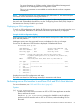
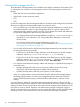
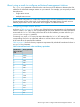
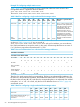
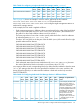
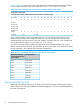
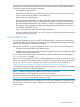
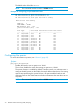

Table 9 (page 66) shows the bits in the fourth block of the mask that determine the valid subnets
in which authorized stations with an IPv6 device ID of 244:17FF:FEB6:D37D reside.
Table 9 How a mask determines authorized IPv6 manager addresses by subnet
Fourth block in mask: FFF8
Last block in IPv6 address: D37DFourth block in prefix ID of IPv6 address: 0000
BitBitBitBitBitBitBitBitBitBitBitBitBitBitBitBitBit numbers
0123456789101112131415
8FFFBit value
0001111111111111
FFF8: Fourth
block in mask
0000000000000000
0000: Fourth
block in IPv6
address
0 = Off1 = OnBit setting:
FFF8 in the fourth block of the mask means that bits 3 to 15 of the block are fixed and, in an
authorized IPv6 address, must correspond to the "on" and "off" settings shown for the binary
equivalent 0000 in the fourth block of the IPv6 address. Conversely, bits 0 to 2 are variable and,
in an authorized IPv6 address, may be either "on" (1) or "off" (0).
As a result, assuming that the seventh and eighth bytes (fourth hexadecimal block) of an IPv6
address are used as the subnet ID, only the following binary expressions and hexadecimal subnet
IDs are supported in this authorized IPv6 manager configuration:
Table 10 Binary equivalents of authorized subnet IDs (in hexadecimal)
Binary equivalentAuthorized subnet ID in
fourth hexadecimal block
of IPv6 address
0000 00000000
0000 00010001
0000 00100002
0000 00110003
0000 01000004
0000 01010005
0000 01100006
0000 01110007
Secure shell (SSH) for IPv6
Beginning with software release K.14.01, SSH for IPv4 and IPv6 operate simultaneously with the
same command set. Both are enabled in the default configuration, and are controlled together by
the same command set.
66 IPv6 Management Security Features