
Multicast and Routing Guide K/KA/KB.15.15


from the backbone into the area (included
in the metric-type operation described
below.)
Default: Disabled
For more information, see
“Not-so-stubby-area (NSSA)” (page 194),
“Stub area” (page 194), and “Replacing
type-3summary LSAs and type-7 default
external LSAs with a type-3 default route
LSA” (page 196).
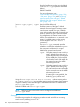
[metric-type[ type1 | type2
]]
Used in NSSA ABRs only.
Enables injection of the type-7 default
external route and type-3 summary routes
into the area instead of a type 3 default
route. Also specifies the type of internal cost
metric to include in type-7 LSAs advertised
for redistribution of external routes in the
NSSA. (The redistribution—or external—cost
metric is a global setting on the routing
switch set by the default-metric
command.)
The metric-type command specifies
whether to include the redistribution cost in
the cost metric calculation for a type-7
default LSA injected into the area.
type1 Calculate external route cost for a
type-7 default LSA as the sum of
(1) the external route cost assigned
by the ASBR plus (2) the internal
cost from the router with traffic for
the external route to the ASBR
advertising the route.
type2 Calculate external route cost for a
type-7 default LSA as being only
the cost from the router with traffic
for the external route to the ASBR
advertising the route.
If metric-type is not specified, the
default (type2) will be used.
Using the area ospf-area-id nssa 0-16777215 without entering either
no-summary or metric-type resets the routing switch to the state where injection
of type-3 summary routes and the type-7 default external routes is enabled with
metric-type set to type2.
Default: Enabled with metric-type type2
NOTE: Different routers in the NSSA can be configured with different
metric-type values.
Examples
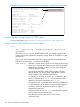
The following examples of configuring a stub area and an NSSA on a routing
switch use an (arbitrary) cost of "10".
144 Open Shortest Path First Protocol (OSPF)