
Multicast and Routing Guide K/KA/KB.15.15

Area border routers (ABRs)
This type of OSPF router has membership in multiple areas . ABRs are used to connect the various
areas in an AS to the backbone area for that AS. Multiple ABRs can be used to connect a given
area to the backbone, and a given ABR can belong to multiple areas other than the backbone.
An ABR maintains a separate LSDB for each area to which it belongs. (All routers within the same
area have identical LSDBs.) The ABR is responsible for flooding summary LSAs between its border
areas. You can reduce summary LSA flooding by configuring area ranges. An area range enables
you to assign an aggregate address to a range of IP addresses. This aggregate address is advertised
instead of all the individual addresses it represents. You can assign up to eight ranges in an OSPF
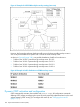
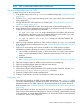
area. In Figure 38 (page 191), routers R2 and R5 are ABRs because they both have membership
in more than one area.
Figure 38 Example of deploying ABRs to connect areas to the backbone
Autonomous system boundary router (ASBR)
This type of OSPF router runs multiple interior gateway protocols and serves as a gateway to other
autonomous systems operating with interior gateway protocols. The ASBR imports and translates
different protocol routes into OSPF through redistribution. ASBRs can be used in backbone areas,
normal areas, and NSSAs, but not in stub areas. For more details on redistribution and configuration
examples, see “Enabling route redistribution” (page 149).
Designated routers (DRs)
In an OSPF network having two or more routers, one router is elected to serve as the DR and
another router to act as the BDR. All other routers in the area forward their routing information to
the DR and BDR, and the DR forwards this information to all of the routers in the network. This
minimizes the amount of repetitive information that is forwarded on the network by eliminating the
need for each individual router in the area to forward its routing information to all other routers in
the network. If the area includes multiple networks, each network elects its own DR and BDR.
In an OSPF network with no DR and no BDR, the neighboring router with the highest priority is
elected the DR, and the router with the next highest priority is elected the BDR. If the DR goes
off-line, the BDR automatically becomes the DR, and the router with the next highest priority then
becomes the new BDR. If multiple HP routing switches on the same OSPF network are declaring
themselves DRs, both priority and router ID are used to select the DR and BDRs.
Priority is configurable by using the vlan vid ip ospf priority 0-255 command at the
interface level. You can use this parameter to help bias one router as the DR. For more information,
see “Changing priority per-interface” (page 156). If two neighbors share the same priority, the
router with the highest router ID is designated the DR. The router with the next highest router ID is
designated the BDR.
Overview of OSPF 191