
Multicast and Routing Guide K/KA/KB.15.15
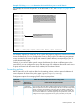
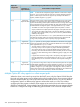
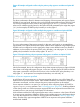
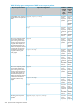
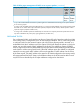
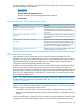
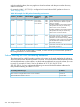

Table 29 Relay agent management of DHCP server response packets. (continued)
Validation
disabled
(the
default)
Validation
enabled
on the
relay
agent
Option 82 configurationResponse packet content
packet to
a
packet to
a
downstream
device.
downstream
device.
1
Drop is the recommended choice because it protects against an unauthorized client inserting its own Option 82 field
for an incoming request.
2
A routing switch with DHCP Option 82 enabled with the keep option forwards all DHCP server response packets except
those that are not valid for either Option 82 DHCP operation (compliant with RFC 3046) or DHCP operation without
Option 82 support (compliant with RFC 2131.)
3
A routing switch with DHCP Option 82 enabled drops an inbound server response packet if the packet does not have
any device identified as the primary relay agent (giaddr=null; see RFC 2131.)
Multinetted VLANs
On a multinetted VLAN, each interface can form an Option 82 policy boundary within that VLAN
if the routing switch is configured to use IP for the remote ID suboption. That is, if the routing switch
is configured with IP as the remote ID option and a DHCP client request packet is received on a
multinetted VLAN, the IP address used in the Option 82 field will identify the subnet on which the
packet was received instead of the IP address for the VLAN. This enables an Option 82 DHCP
server to support more narrowly defined DHCP policy boundaries instead of defining the boundaries
at the VLAN or whole routing switch levels. If the MAC address option (the default) is configured
instead, the routing switch MAC address will be used regardless of which subnet was the source
of the client request. (The MAC address is the same for all VLANs configured on the routing switch.)
All request packets from DHCP clients in the different subnets in the VLAN must be able to reach
any DHCP server identified by the IP helper addresses configured on that VLAN.
DHCP Option 82 245