
Multicast and Routing Guide K/KA/KB.15.15

group, and all devices in the group use the same multicast group address. The multicast group
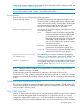
running version 2 of IGMP uses three fundamental types of messages to communicate:
Query A message sent from the querier (multicast router or switch) asking for a
response from each host belonging to the multicast group. If a multicast router
supporting IGMP is not present, the switch must assume this function to elicit
group membership information from the hosts on the network. If you need
to disable the querier feature, do so through the CLI using the IGMP
configuration MIB.
Report (Join) A message sent by a host to the querier to indicate that the host wants to be
or is a member of a given group indicated in the report message.
Leave group A message sent by a host to the querier to indicate that the host has ceased
to be a member of a specific multicast group.
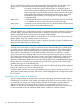
Note on IGMP version 3 support:
When an IGMPv3 Join is received by the switch, it accepts the host request and begins to forward
the IGMP traffic. This means that ports that have not joined the group and are not connected to
routers or the IGMP Querier will not receive the group's multicast traffic.
The switch does not support the IGMPv3 "Exclude Source" or "Include Source" options in the Join
Reports. Rather, the group is simply joined from all sources.
The switch does not support becoming a version 3 Querier. It becomes a version 2 Querier in the
absence of any other Querier on the network.
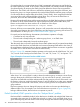
An IP multicast packet includes the multicast group (address) to which the packet belongs. When
an IGMP client connected to a switch port needs to receive multicast traffic from a specific group,
it joins the group by sending an IGMP report (join request) to the network. (The multicast group
specified in the join request is determined by the requesting application running on the IGMP
client.) When a networking device with IGMP enabled receives the join request for a specific
group, it forwards any IP multicast traffic it receives for that group through the port on which the
join request was received. When the client is ready to leave the multicast group, it sends a Leave
Group message to the network and ceases to be a group member. When the leave request is
detected, the appropriate IGMP device ceases transmitting traffic for the designated multicast group
through the port on which the leave request was received (as long as there are no other current
members of that group on the affected port.)
Thus, IGMP identifies members of a multicast group (within a subnet) and allows IGMP-configured
hosts (and routers) to join or leave multicast groups.
To display IGMP data showing active group addresses, reports, queries, querier access port, and
active group address data (port, type, and access), see the Management and Configuration Guide
for your switch.
Operation with or without IP addressing
You can configure IGMP on VLANs that do not have IP addressing. The benefit of IGMP without
IP addressing is a reduction in the number of IP addresses you have to use and configure. This can
be significant in a network with a large number of VLANs. The limitation on IGMP without IP
addressing is that the switch cannot become Querier on any VLANs for which it has no IP
address—so the network administrator must ensure that another IGMP device will act as Querier.
It is also advisable to have an additional IGMP device available as a backup Querier.
26 Multimedia Traffic Control with IP Multicast (IGMP)