
Multicast and Routing Guide K/KA/KB.15.15
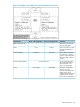

In Figure 53 (page 275):
• Host "A" uses 10.10.100.1 as its next-hop gateway out of the subnet, as represented by the
VR (VR 1.)
• Router 1 (the configured owner) advertises itself as the master in the VR supporting the
gateway and:
• "Owns" the VR's (virtual) IP address
• Transmits ARP responses that associate the VR's VIP with the (shared) source MAC
address for VR 1.
• During normal operation, Router 1 forwards the routed traffic for host "A."
• If Router 1 fails or otherwise becomes unavailable:
Router 1 advertisements of its master status for VR 1 fail to reach Router 2 (which is the
only configured backup.)
a.
b. After the time-out period for receiving master advertisements expires on Router 2, the VR
initiates a failover to Router 2 and it becomes the new master of the VR.
c. Router 2 advertises itself as the master of the VR supporting the gateway and:
• Takes control of the VR's (virtual) IP address
• Begins transmitting ARP responses that associate the VR's VIP with the (shared) source
MAC address for VR 1
d. Host "A" routed traffic then moves through Router 2.
• If Router 1 again becomes available:
Router 1 resumes advertising itself as the master for the VR and sends ARP responses that
associate the VR's VIP with the (shared) source MAC address for VR 1.
a.
b. Router 2 receives the advertisement from Router 1 and ceases to operate as the VR's
master, and halts further transmission of its own VRRP advertisements and ARP responses
related to VR 1.
c. The VR executes a failback to Router 1 as master, and Host "A" traffic again moves
through Router 1.
Virtual router (VR)
A VR instance consists of one owner router and one or more backup routers belonging to the same
network. Any VR instance exists within a specific VLAN, and all members of a given VR must belong
to the same subnet. In a multinetted VLAN, multiple VRs can be configured. The owner operates
as the VR's master unless it becomes unavailable, in which case the highest-priority backup becomes
the VR's master.
A VR includes the following:
• VR identification (VRID) configured on all VRRP routers in the same network or, in the case of
a multinetted VLAN, on all routers in the same subnet .
• Same VIP configured on each instance of the same VR.
• Satus of either owner or backup configured on each instance of the same VR (on a given VR,
there can be one owner and one or more backups.)
• Priority level configured on each instance of the VR (on the owner router the highest priority
setting, 255, is automatically fixed; on backups, the default priority setting is 100 and is
configurable.)
• VR MAC address (not configurable.)
Where a VLAN is configured with only one network (IP address), one VR is allowed in that VLAN.
In a multinetted VLAN, there can be one VR per subnet, with a maximum of 32 VRs in any
combination of masters and backups.
276 Virtual Router Redundancy Protocol (VRRP)