
Multicast and Routing Guide K/KA/KB.15.15
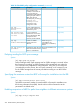
Comparing preferences for route selection
Syntax:
[no] neighbor ipv4-addr weight weight
Preferences are the first criteria of comparison for route selection. This value defaults
to the globally configured preference if it is not specified.
Sending a community's attribute to a BGP neighbor
Syntax:
[no]neighbor ipv4-addr send-community
To specify that a community’s attribute should be sent to a BGP neighbor, use the neighbor
send-community command in address family or router configuration mode. To remove the entry,
use the no form of this command. By default the communities attribute is sent to all peers.
Processing sent and received MEDs
Syntax:
[no] neighbor ipv4-addr use-med
Processes sending of MEDS and handles received MEDs. When two routes to the
same destination are received from different peers within the same peer as, they
may have different MEDs. When choosing between these routes, assuming that
nothing else makes one preferable to the other (such as configured policy), the
values of the differing MEDs are used to choose which route to use. In this
comparison, the route with the lowest MED is preferred. Routes without MEDs are
treated as having a MED value of zero. By default, MEDs are used to choose which
route to use.
Setting the timer for a BGP peer
Syntax:
[no] neighbor ipv4-addr timers keep-alive hold-time
To set the timers for a specific BGP peer, use the neighbor timers command
in router configuration mode. To clear the timers for a specific BGP peer, use the
no form of this command. The values of keep-alive and hold-time default to 60 and
180 seconds, respectively.
The timers configured for a specific neighbor override the timers configured for all
BGP neighbors using the timers command.
Resetting BGP peering sessions
Syntax:
clear ip bgp [neighbor ipv4-addr] [ soft ]
Resets BGP peering sessions; sends route refresh requests if ‘soft’.
Enabling or disabling multi-hop peering
Syntax:
[no] neighbor ipv4-addr ibgp-multihop [ttl]
Enables or disables multi-hop peering with the specified EBGP peer, and optionally
indicates the maximum number of hops (TTL.)
300 Border Gateway Protocol (BGP)