
Multicast and Routing Guide K/KA/KB.15.15
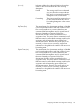
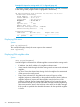

Example 19 Upstream router prune
A network may have multiple routing switches sharing VLAN "X". When an upstream
routing switch initially floods traffic from multicast group "X" to VLAN "Y", if one
of the routing switches on VLAN "Y" does not want this traffic, it issues a prune
response to the upstream neighbor. The upstream neighbor then goes into a prune
pending state for group "X" on VLAN "Y". (During this period, the upstream neighbor
continues to forward the traffic.)
During the prune pending period, another routing switch on VLAN "Y" can send
a group "X" Join to the upstream neighbor. If this happens, the upstream neighbor
drops the prune pending state and continues forwarding the traffic. If no routers on
the VLAN send a Join, the upstream router prunes group "X" from VLAN "Y" when
the lan-prune-delay timer expires.
Setting the multicast datagram time-to-live (router hop-count) threshold for the VLAN
Syntax:
ip pim-dense [ttl-threshold[0-255]]
vlan[vid]ip pim-dense [ttl-threshold[0-255]]
Sets the multicast datagram time-to-live (router hop-count) threshold for the VLAN.
Any IP multicast datagrams or state-refresh packets with a TTL less than this threshold
will not be forwarded out the interface. The default value of 0 means all multicast
packets are forwarded out the interface.
The VLAN connected to the multicast source does not receive state refresh packets
and thus is not state-refresh capable. Downstream VLANs in the switches covered
in this guide are state-refresh capable. This parameter provides a method for
containing multicast traffic within a network, or even within specific areas of a
network. Initially, the multicast traffic source sets a TTL value in the packets it
transmits. Each time one of these packets passes through a multicast routing device,
the TTL setting decrements by 1. If the packet arrives with a TTL lower than the
mroute ttl-threshold, the routing switch does not forward the packet.
Changing this parameter on a routing switch requires knowledge of the TTL setting
of incoming multicast packets:
• A value that is too high can allow multicast traffic to go beyond your internal
network.
• A value that is too low may prevent some intended hosts from receiving the
desired multicast traffic.
Default: 0—forwards multicast traffic regardless of packet TTL setting
Example of configuring PIM-DM operation at the VLAN level
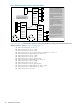
The network in Figure 8 (page 44) uses VLAN 25 for multicast traffic. However, this VLAN is
multinetted and there is only one subnet (10.38.10.x) in VLAN 25 that is common to all three
routing switches. Thus, when configuring VLAN 25 on these routing switches to perform multicast
routing, it is necessary to use ip pim-dense source-ip-address to designate the common
subnet as the source address for outbound multicast traffic on VLAN 25. (If only identical subnets
were present in the multinetted VLAN 25 configuration on all three devices, the ip pim-dense
ip-addr any command would be used instead.) The other VLANs in the network are not
multinetted and therefore do not require the ip pim-dense ip-addr
any|source-ip-address option.
For this example, assume that the VLANs and IP addressing are already configured on the routing
switch.
PIM VLAN (interface) configuration context 43