
Multicast and Routing Guide K/KA/KB.15.15
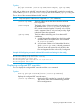

Enables and disables the following PIM SNMP traps:
all Enable/Disable all PIM notification traps.
(Default: Disabled)
neighbor-loss Enable/Disable the notification trap sent when the timer
for a multicast router neighbor expires and the switch
has no other multicast router neighbors on the same
VLAN with a lower IP address.
(Default: Disabled)
hardware-mrt-full Enable/Disable notification trap sent when the
hardware multicast routing table (MRT) is full (2048
active flows.) In this state, any additional flows are
handled by the software MRT, which increases
processing time for the affected flows.
(Default: Disabled)
software-mrt-full Enable/Disable notification trap sent when the router's
software MRT is full (that is, when routing resources for
active flows are exhausted.) Note that in this state, the
router does not accept any additional flows.
(Default: Disabled)
NOTE: Trap operation requires configuring an SNMP trap receiver by using the
snmp-server host[ip-addr] command at the global configuration level.
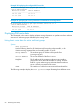
Changing the global join-prune interval on the router
Syntax:
router pim join-prune-interval [5-65535]
Sets the interval in seconds at which periodic PIM-SM join/prune messages are to
be sent on the router's PIM-SM interfaces. This setting is applied to every PIM-SM
interface on the router.
(Default: 60 seconds)
NOTE: All routers in a PIM-SM domain should have the same join-prune-interval
setting.
Changing the shortest-path tree (SPT) operation
Generally, using the SPT option eliminates unnecessary levels of PIM-SM traffic in a domain.
However, in cases where it is necessary to tightly control the paths used by PIM-SM flows to edge
switches, disabling SPT maintains the flows through their original C-RPs regardless of whether
shorter paths exist.
Syntax:
router pim spt-threshold
[no] router pim spt-threshold
When the router is the edge router for a receiver requesting to join a particular
multicast group, this command enables or disables the capability of the router to
convert the group's traffic from the RPT to the SPT.
See “Restricting multicast traffic to RPTs” (page 96).
(Default: Enabled)
76 PIM-SM (Sparse Mode)