
Multicast and Routing Guide K/KA/KB.15.15

Restricting multicast traffic to RPTs
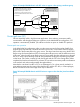
An alternate method to allowing the domain to use SPTs is to configure all of the routers in the
domain to use only RPTs. However, doing so can increase the traffic load in the network and cause
delays in packet delivery.
Maintaining an active route for multicast group members
The edge router itself and any intervening routers on the active tree between the members (receivers)
of a multicast group and the DR for that group, send periodic joins. This keeps the active route
available for as long as there is a multicast receiver requesting the group. When a route times out
or is pruned, the DR ceases to send the requested group traffic on that route.
Border routers and multiple PIM-SM domains
Creating multiple domains enables a balancing of PIM-SM traffic within a network. Defining PIM-SM
domain boundaries requires the use of PIM border routers (PMBRs), and multiple PMBRs can be
used between any two domains.
NOTE: The software described in this guide does not support PMBR operation for PIM-SM
networks.
Pim-SM router types
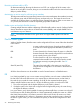
Within a PIM-SM domain, PIM-SM routers can be configured to fill one or more of the roles described
in this section.
DR: A router performing this function forwards multicast traffic from
a unicast source to the appropriate distribution (rendezvous)
point.
BSR: A router elected to this function keeps all routers in a PIM-SM
domain informed of the currently assigned RP for each multicast
group currently known in the domain.
RP: A router elected as a RP for a multicast group receives
requested multicast traffic from a DR and forwards it toward
the multicast receiver(s) requesting the traffic. See “RP”
(page 97).
Static RP (static RP): This option forwards traffic in the same way as an RP, but
requires manual configuration on all routers in the domain to
be effective.
All of the above functions can be enabled on each of several routers in a PIMSM domain.
DR
In a VLAN populated by one or more routers running PIM-SM, one such router is elected the DR
for that VLAN. When the DR receives a Join request from a multicast receiver on that VLAN, it
forwards the join toward the router operating as the RP for the requested multicast group.
Where multiple PIM-SM routers exist in a VLAN, the following criteria is used to elect a DR:
1. The router configured with the highest DR priority in the VLAN is elected.
2. If multiple routers in the VLAN are configured with the highest DR priority, the router having
the highest IP address is elected.
In a given domain, each VLAN capable of receiving multicast traffic from a unicast source should
have at least one DR. (Enabling PIM-SM on a VLAN automatically enables the router as a DR for
that VLAN.) Because there is an election process for DR on each VLAN, all routers on a VLAN
need to be enabled for DR. Where it is important to ensure that a particular router is elected as
the DR for a given VLAN, you can increase the DR priority on that VLAN configuration for that
router.
96 PIM-SM (Sparse Mode)