
Advanced Traffic Management Guide K/KA/KB.15.15



Troubleshooting MSTP operation
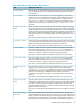
Table 10 Troubleshooting MSTP operation
Possible causeProblem
The allocation of VLANs to MSTIs may not be identical among all switches in a region.Duplicate packets on a
VLAN, or packets not
arriving on a LAN at all.
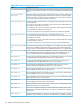
An MSTP switch intended for a particular region may not have the same configuration
name or region revision number as the other switches intended for the same region. The
A switch intended to
operate in a region does
MSTP configuration name (spanning-tree config-name command) and MSTPnot receive traffic from
other switches in the
region.
configuration revision number (spanning-tree config-revision command) must
be identical on all MSTP switches intended for the same region.
Another possible cause is that the set of VLANs and VLAN ID-to-MSTI mappings
(spanning-tree instance vlan command) configured on the switch may not match
the set of VLANs and VLAN ID-to-MSTI mappings configured on other switches in the
intended region.
About MSTP
Overview
Without spanning tree, having more than one active path between a pair of nodes causes loops
in the network, which can result in duplication of messages leading to a "broadcast storm" that
can bring down the network.
NOTE:
MSTP cannot protect against loops when there is an unmanaged device on the network that drops
spanning tree packets, or may fail to detect loops where this is an edge port configured with client
authentication (802.1X, Web and MAC authentication). To protect against the formation of loops
in these cases, you can use the loop protection feature.
Multiple-Instance spanning tree operation (802.1s) ensures that only one active path exists between
any two nodes in a spanning tree instance. A spanning tree instance comprises a unique set of
VLANs, and belongs to a specific spanning tree region. A region can comprise multiple spanning
tree instances (each with a different set of VLANs), and allows one active path among regions in
a network. Applying VLAN tagging to the ports in a multiple-instance spanning tree network enables
blocking of redundant links in one instance while allowing forwarding over the same links for
non-redundant use by another instance.
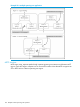
Example 92 VLAN/Instance groupings
Suppose there are three switches in a region configured with VLANs grouped into two instances,
as follows:
Instance 2Instance 1VLANs
NoYes10, 11, 12
YesNo20, 21, 22
The logical and physical topologies resulting from these VLAN/Instance groupings result in blocking
on different links for different VLANs:
About MSTP 119