
Advanced Traffic Management Guide K/KA/KB.15.15
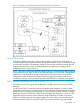



As a result, each individual instance (spanning tree) within a region determines its regional root
bridge, designated bridges, and designated ports or trunks.
Regions, legacy STP and RSTP switches, and the Common Spanning Tree (CST)
The IST instance and any MST instances in a region exist only within that region. Where a link
crosses a boundary between regions (or between a region and a legacy STP or RSTP switch),
traffic is forwarded or blocked as determined by the Common Spanning Tree (CST). The CST
ensures that there is only one active path between any two regions, or between a region and a
switch running STP and RSTP. (See Figure 17 (page 121).)
MSTP operation with 802.1Q VLANs
As indicated in the preceding sections, within a given MST instance, a single spanning tree is
configured for all VLANs included in that instance. This means that if redundant physical links exist
in separate VLANs within the same instance, MSTP blocks all but one of those links. However, you
can prevent the bandwidth loss caused by blocked redundant links for different VLANs in an
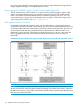
instance by using a port trunk. The following example shows how you can use a port trunk with
802.1Q (tagged) VLANs and MSTP without unnecessarily blocking any links or losing any
bandwidth.
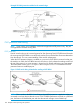
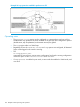
Example 94 Using a trunked link to support multiple VLAN connectivity within the same MST instance
NOTE: All switches in a region should be configured with the VLANs used in that region, and
all ports linking MSTP switches together should be members of all VLANs in the region. Otherwise,
the path to the root for a given VLAN will be broken if MSTP selects a spanning tree through a link
that does not include that VLAN.
124 Multiple instance spanning tree operation