
Advanced Traffic Management Guide K/KA/KB.15.15


Default: Disabled
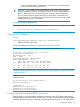
Example 101 RPVST+ behavior
Table 11 RPVST+ behavior with ignore-pvid-inconsistency enabled
RPVST+ behavior with ignore-pvid-inconsistency
enabledSwitch “B” Peer port on VLAN YSwitch “A” Port on VLAN X
Forward
1
Untagged on VLAN 10Untagged on VLAN 10
Forward
1, 2
Untagged on VLAN 20Untagged on VLAN 10
DropTagged on VLAN XUntagged on VLAN X
Drop (traffic from both VLANs)Tagged on VLAN YUntagged on VLAN X
Forward
1
Tagged on VLAN XTagged on VLAN X
Drop (traffic from both VLANs)Tagged on VLAN YTagged on VLAN X
1
Forwarding state applies if the link has not been blocked by RPVST+ as a redundant link.
2
If both sides (ports) of the link are untagged to different VLANs, but the VLAN on the switch on one end of the link is not
RPVST+-enabled, untagged RPVST+ frames received on that switch port (where RPVST+ is disabled) would be forwarded
to any other ports belonging to the inbound VLAN.
Configuring STP loop guard
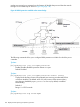
Spanning tree is used to ensure a loop-free topology over the LAN. Occasionally a hardware or
software failure can cause STP to fail, creating STP/ forwarding loops that can cause network
failures where unidirectional links are used. The non-designated port transitions in a faulty manner
because the port is no longer receiving STP BPDUs.
STP Loop Guard causes the non-designated port to go into the STP loop inconsistent state instead
of the forwarding state. In the loop-inconsistent state, the port prevents data traffic through the link,
therefore avoiding the loop creation. When BPDUs again are received on the inconsistent port, it
resumes normal STP operation automatically.
Syntax:
[no] spanning-tree port-list loop-guard
Enables STP Loop Guard on a particular port or ports. STP Loop Guard is best
applied on blocking or forwarding ports.
The no form of the command disables STP Loop Guard.
Default: Disabled
Figure 21 Loop creation with transmission failure
140 Rapid per-VLAN spanning tree (RPVST+) operation