
Advanced Traffic Management Guide K/KA/KB.15.15
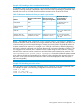


Example 116 Calculating per-module vPorts on chassis switches
In addition to the switch-wide active vPort count, there is a vPort count per port module determined
by the number of ports per line card that are members of each VLAN. Also, on modular switches,
if a VLAN includes a trunk configured with ports on more than one module, then one vPort is
counted for each module on which the trunk exists (regardless of how many ports are included in
the trunk.) For example, in the following configuration, VLANs 1, 20, and 30 have a total of 74
vPorts.
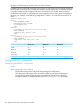
trunk A1,A2,B1 trk1
vlan 1
name “DEFAULT_VLAN”
untagged A3-A24, B2-B24
no untagged trk1
exit
vlan 20
ip address 10.243.230.75 255.255.255.248
name “VLAN20”
tagged A3-A12, B2-B12, trk1
exit
vlan 30
ip address 10.243.230.83 255.255/255/248
name “VLAN30”
tagged A13, A14, B13, B14, trk1
exit
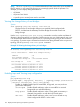
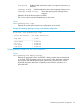
All ModulesModule “B”Module “A”
42322VLAN 1
2311 + 110 + 1VLAN 20
62 + 12 + 1VLAN 30
743836Total vPorts
Viewing the RPVST+ configuration
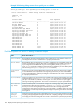
Viewing the global RPVST+ configuration
Syntax:
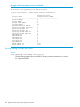
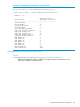
show spanning-tree config
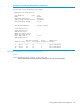
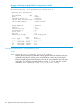
Displays the switch’s basic and per-VLAN spanning tree configuration.
The upper part of the output shows the switch’s global spanning tree configuration.
The port listing shows the spanning tree port parameter settings for the spanning
tree region operation (configured by the spanning-tree port-list command).
152 Rapid per-VLAN spanning tree (RPVST+) operation