
Advanced Traffic Management Guide K/KA/KB.15.15

Operating notes for switch meshing
In a switch mesh domain traffic is distributed across the available paths with an effort to keep
latency the same from path to path. The path selected at any time for a connection between a
source node and a destination node is based on these latency and throughput cost factors:
• Outbound queue depth, or the current outbound load factor for any given outbound port in
a possible path
• Port speed, such as 10Mbps versus 100Mbps; full-duplex or half-duplex
• Inbound queue depth, or how busy a destination switch is in a possible path
• Increased packet drops, indicating an overloaded port or switch
Pathshaving a lower cost will have more traffic added than those having a higher cost. Alternate
paths and cost information is discovered periodically and communicated to the switches in the
mesh domain. This information is used to assign traffic paths between devices that are newly active
on the mesh. This means that after an assigned path between two devices has timed out, new
traffic between the same two devices may take a different path than previously used.
Flooded traffic
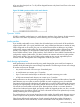
Broadcast and multicast packets will always use the same path between the source and destination
edge switches unless link failures create the need to select new paths. (Broadcast and multicast
traffic entering the mesh from different edge switches are likely to take different paths.) When an
edge switch receives a broadcast from a non-mesh port, it floods the broadcast out all its other
non-mesh ports, but sends the broadcast out only those ports in the mesh that represent the path
from that edge switch through the mesh domain. (Only one copy of the broadcast packet gets to
each edge switch for broadcast out of its non-meshed ports. This helps to keep the latency for these
packets to each switch as low as possible.)
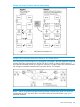
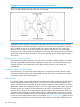
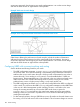
Example 140 A broadcast path through a switch mesh domain
Any mesh switches that are not edge switches will flood the broadcast packets only through ports
(paths) that link to separate edge switches in the controlled broadcast tree. The edge switches that
receive the broadcast will flood the broadcast out all non-meshed ports. Some variations on
broadcast/multicast traffic patterns, including the situation where multiple VLANs are configured
and a broadcast path through the mesh domain leads only to ports that are in the same VLAN as
the device originating the broadcast.
About switch meshing 181