
Advanced Traffic Management Guide K/KA/KB.15.15



4 flash-override
5 critical
6 internet (for internetwork control)
7 network (for network control)
Table 17 (page 242) shows how the Layer 2
802.1p priority value determines to which
outbound port queue a packet is sent.
Table 22 (page 251) shows the 802.1p
priority value (0 to 7) associated, by default,
with each IP Precedence three-bit setting and
automatically assigned by the switch to the
Layer 2 header of matching packets.
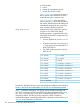
dscp dscp-value Configures the DSCP codepoint in the IPv4
ToS byte or IPv6 Traffic Class byte of
matching packets in a specified traffic class.
Valid values for the DSCP codepoint are any
of the following:
• A binary eight-bit set (such as 100110
)
• A decimal value from 0 (low priority) to
63 (high priority) that corresponds to a
binary DSCP bit set
• The ASCII standard name for a binary
DSCP bit set:
af42 (100100)af11 (001010)
af43 (100110)af12 (001100)
ef (101110)af13 (001110)
cs1 (001000) = precedence 1af21 (010010)
cs2 (010000) = precedence 2af22 (010100)
cs3 (011000) = precedence 3af23 (010110)
cs4 (100000) = precedence 4af31 (011010)
cs5 (101000) = precedence 5af32 (011100)
cs6 (110000) = precedence 6af33 (011110)
cs7 (111000) = precedence 7af41 (100010)
default (000000)
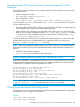
Prerequisite: The DSCP value you enter must already be configured with an 802.1p
priority in the DSCP Policy table before you can use it to mark matching packets.
NOTE: DSCP-802.1p Mapping: The 802.1p priority currently associated with
each DSCP codepoint is stored in the DSCP Policy table (displayed with the show
qos dscp-map command. Certain DSCP codepoints have 802.1p priorities
assigned by default. The 802.1p priority mapped to a DSCP codepoint is
automatically applied in matching packets whose codepoint is reset with the class
action dscp command in a QoS policy.
228 Quality of Service: Managing bandwidth effectively