
Advanced Traffic Management Guide K/KA/KB.15.15


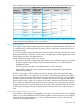
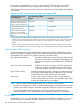
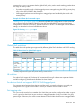
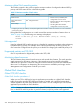

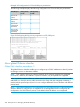

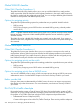

Table 18 Mapping 802.1p priorities to outbound port queues on the switch and downstream devices
Queue assignment in downstream devices with:802.1p priority
added to taggedOutbound port
queue in the
switch
Configured
802.1p priority
2 queues4 queues8 queues
VLAN packets
exiting the switch
Queue 1
Queue 1
Queue 11 (low priority)Queue 11
Queue 22Queue 22
Queue 2
Queue 30 (normal
priority)
Queue 30
Queue 43Queue 43
Queue 2
Queue 3
Queue 54 (medium
priority)
Queue 54
Queue 65Queue 65
Queue 4
Queue 76 (high priority)Queue 76
Queue 87Queue 87
NOTE: You can reconfigure the QoS queue setting to change the number of outbound port queues
in the switch from eight (default) to four or two queues.
Layer 3 DSCP marking
By changing or honoring the settings of the DSCP codepoint in IP packet headers, QoS allows you
to control the DSCP and associated 802.1p priority values in outbound IP packets that are sent to
downstream devices.
You can later configure downstream devices to read and use the DSCP policy that QoS sets. When
marking the DSCP bits in IP packets, a QoS policy is not dependent on VLAN-tagged ports to carry
802.1p packet priorities to downstream devices.
When configuring a Layer 3 DSCP policy, specify:
• Bit values for the DSCP codepoint (the upper six bits in the ToS/Traffic Class byte in IP packet
headers), entered in either binary format, the decimal equivalent, or an ASCII standard
(hexadecimal) name
• An 802.1p priority value that is associated with the new DSCP bit values
Certain DSCP codepoints (such as Assured Forwarding and Expedited Forwarding) have
default 802.1p priorities.
A DSCP policy assigns a DSCP codepoint and 802.1p priority value to IPv4 and IPv6 packets.
You can classify traffic on an edge switch and use Layer 3 DSCP-marking (instead of only 802.1p
priority) to assign and preserve QoS policies on downstream devices. In this case, if you reconfigure
the 802.1p priority associated with the DSCP codepoint, the new 802.1p assignment takes effect
starting on the switch on which it is configured and is used in packets sent to downstream devices.
If you configure a different 802.1p priority for a DSCP codepoint, the new DSCP policy overrides
the 802.1p priority value in packets which enter the switch with the specified codepoint. The Layer
2 802.1p priority setting (0 through 7) determines the outbound port queue to which a packet is
sent.
VLAN and untagged VLAN environments
QoS operates in VLAN-tagged and untagged environments. If your network does not use multiple
VLANs, you can still implement the 802.1Q VLAN capability to allow packets to carry an 802.1p
priority to the next downstream device. To do so, configure the ports on links to other network
devices as VLAN-tagged members.
About QoS 243