
Advanced Traffic Management Guide K/KA/KB.15.15
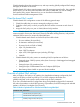
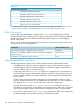
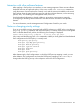
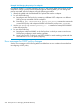

Comparing global IP type-of-service classifiers
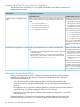
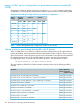
The next table shows the difference in how global IP-Precedence and IP-Diffserv classifiers are
implemented in the switch.
IP Type-of-Service classifiersOutbound port
IP differentiated services modeIP-Precedence mode
Based on the DSCP codepoint that the switch has been configured to detect, one
of the following actions is taken:
Based on the IP Precedence bit set in a packet's ToS/Traffic Class
field, the packet is sent to one of eight outbound port queues in the
switch:
IP Packet Sent Out an Untagged Port in a
VLAN
• The codepoint is re-marked according to the configured DSCP policy and the
802.1p priority currently configured for the codepoint in the DSCP Policy.• 1 - 2 = low priority (queue 1, 2)
• The codepoint is not changed, but the 802.1p priority is marked with the currently
configured value for the codepoint in the DSCP Policy table.
• 0 - 3 = normal priority (queue 3, 4)
• 4 - 5 = medium priority (queue 5, 6)
Based on the new 802.1p priority marking, the packet leaves the switch through
one of the following queues:
• 6 - 7 = high priority (queue 7, 8)
• 1 - 2 = low priority (queue 1, 2)
• 0 - 3 = normal priority (queue 3, 4)
• 4 - 5 = medium priority (queue 5, 6)
• 6 - 7 = high priority (queue 7, 8)
If No-override (the default) is configured for the 802.1p priority associated with
a codepoint, the priority in the packet header is not re-marked by the global
IP-Diffserv classifier and, by default, is sent to the "normal priority" outbound port
queue.
Based on the DSCP codepoint that the switch has been configured to detect, one
of the following actions is taken:
Based on the IP Precedence bit set in a packet's ToS/Traffic Class
field:
IP Packet Sent Out a Tagged Port in a VLAN
• The codepoint is re-marked according to the configured DSCP policy and the
802.1p priority currently configured for the codepoint in the DSCP Policy Table
(Table 22 (page 251)).
• The packet is sent to one of eight outbound port queues in the switch
as described above.
• The IP Precedence value (0 - 7) is used to set the corresponding
802.1p priority in the VLAN tag carried by the packet to the next
downstream device (see Table 22 (page 251)).
• The codepoint is not changed, but the 802.1p priority is marked with the currently
configured value for the codepoint in the DSCP Policy Table (Table 22
(page 251)).
Based on the new 802.1p priority marking, the packet leaves the switch through
one of the outbound port queues described above.
In addition, the priority value (0 - 7) is used to set the 802.1p priority in the VLAN
tag carried by the packet to the next downstream device. If the priority is configured
as No-override in the DSCP Policy table, the VLAN tag carries a "0" (normal
priority) 802.1p setting if not prioritized by other global QoS classifiers.
Advanced classifier-based QoS
Starting in software release K.14.01, in addition to the packet classification and prioritization
methods, QoS configuration also supports advanced classifier-based functions. Advanced
classifier-basedQoS introduces:
• A finer granularity than globally-configured QoS for classifying IPv4 andIPv6 traffic
• Additional actions for managing selected traffic, such as rate limiting and IP precedence
marking
• The application of QoS policies to inbound traffic flows on specific port and VLAN interfaces
(instead of using only globally-configured, switch-wide QoS settings)
• The ability to re-use traffic classes in different software-feature configurations, such as QoS
and port mirroring
Classifier-based QoS is designed to work with existing globally-configured, switch-wide QoS
policies by allowing you to zoom in on a subset of port or VLAN traffic to further manage it.
254 Quality of Service: Managing bandwidth effectively