
Advanced Traffic Management Guide K/KA/KB.15.15
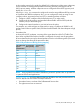
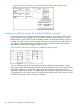
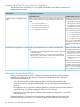
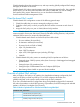
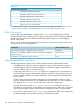
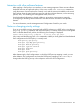
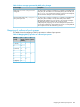
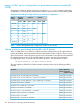

Table 23 Order of precedence for classifier-based QoS over global QoS
(continued)
QoS featurePrecedence order
Globally-configured IP-device priority4
Globally-configured IP Type-of-Service priority5
Globally-configured Layer 3-Protocol priority6
Globally-configured VLAN-ID priority7
Globally-configured Source-Port priority8
802.1p CoS in Layer 2 VLAN header
1
9
1
In a tagged VLAN environment, the incoming 802.1p priority is used as the default QoS classifier to determine how a
packet is handled if no global or classifier-based QoS match criterion with a higher precedence matches.
Effect of No-override
If you configure a global IP-Diffserv classifier and No-override is displayed for the 802.1p
priority associated with a codepoint, DSCP marking cannot be performed on matching outbound
packets. However, QoS does not affect the packet-queuing 802.1p priority or VLAN tagging
carried in the packet.
In this case, the packets are handled as follows (as long as no other QoS classifier marks a new
802.1p priority on the matching packets):
Outbound 802.1p priority802.1Q status
UnchangedReceived and forwarded on a tagged-port member of a VLAN
0 (zero) normalReceived on an untagged-port member of a VLAN; forwarded on a tagged-port
member of a VLAN
NoneForwarded on an untagged-port member of a VLAN
Classifier-based QoS restrictions
The following restrictions apply to QoS policies configured with the classifier-based model:
• A classifier-based QoS policy cannot be applied on a port or VLAN interface on which a
classifier-based QoS policy is already configured. It is possible to apply a classifier-based
policy of a different type, such as port mirroring.
• A QoS policy that uses the rate-limit command is not supported on a port interface on
which ICMP rate limiting has already been globally configured. To apply the QoS policy, you
must first disable the ICMP rate limiting configuration. See the Multicast and Routing Guide
for your switch.
In cases where an ICMP rate limiting configuration is to be maintained, configure a QoS
policy by adding the necessary match statements for the ICMP traffic in a class configuration,
then configure a rate-limit action for the class in the policy configuration.
• In a QoS policy that uses the class action rate-limit command, the rate limit is
calculated on a per-module or per port-bank basis. If trunked ports or VLANs with a configured
rate limit span multiple modules or port-banks, the configured rate limit is not guaranteed.
• In a QoS policy that uses the class action dscp command, the DSCP value entered must
be already configured with an 802.1p priority in the DSCP Policy table.
256 Quality of Service: Managing bandwidth effectively