
Advanced Traffic Management Guide K/KA/KB.15.15
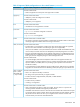
VLAN configuration restrictions in
mixed VLAN mode
Both C-VLANs and S-VLANs can be configured on the
switch. In a mixed mode device, the default VLAN is
always a C-VLAN.
•
• VLAN types cannot be updated dynamically. A VLAN
can be classified only as an S-VLAN or a C-VLAN at
the time its created. Once created, the VLAN cannot
be moved between being a C-VLAN and an S-VLAN.
If a VID that was initially created as a regular VLAN
needs to be used for an S-VLAN, the VID must be
deleted and re-created as an S-VLAN.
• If a VLAN being configured as an S-VLAN already
exists as a GVRP C-VLAN or a static C-VLAN on the
switch, the S-VLAN creation is blocked. Similarly, a
C-VLAN creation is blocked if the same VID exists as
a static S-VLAN on the device.
• S-VLANs in a mixed vlan device cannot be configured
as avoice-VLAN, primary-VLAN, or management-VLAN.
• S-VLANs cannot be configured with ip-layer
functionality, except for ip-acls.
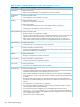
VLAN configuration restrictions in
S-VLAN mode
Only S-VLANs are supported—the keyword on all
vlan-related command syntax changes from vlan to
svlan.
•
• Routing related features such as ip-routing, RIP, OSPF,
PIM, and VRRP are not supported in S-VLAN mode.
Port-based restrictions
In QinQ mixed VLAN mode, a port must be explicitly
GVRP-disabled before it can be assigned to the S-VLAN
space.
•
• In QinQ mixed VLAN mode, only ports that are
members of S-VLANs can be configured as customer
network or provider network ports; ports that are
members of C-VLANs cannot be configured to any
port-type.
• QinQ mixed VLAN mode devices cannot be connected
in an S-VLAN mesh topology. This is because STP
cannot be run in the S-VLAN space, and so a mesh
topology (or the presence of any redundant links) would
result in loops.
• A port can either be a member of S-VLANs or C-VLANs
only, but not a combination of both.
• A port cannot be configured as a Customer-Edge as
specified in Section 12.13.3 of the IEEE 802.1ad
specification. In the current software release, such
C-tagged interfaces are not supported—only
port-based/S-tagged interfaces are supported.
• Moving ports between C-VLANs and S-VLANs may
cause conflicts. For example, if a port has any
mirroring/monitoring sessions set up, they will not be
allowed to change VLAN domains until these sessions
are unconfigured.
336 QinQ (Provider bridging)