
Advanced Traffic Management Guide K/KA/KB.15.15

Interoperating with other vendor
devices
When enabling QinQ, you can configure a unique tpid
value, such as 0x8100, to allow the device to interoperate
with devices that require this value for the inner and outer
VLAN-tag. If the provider tag-type is configured as 0x8100,
then:
• Customer-network ports cannot be configured as
tagged-S-VLAN members
• Tagged-S-VLAN members cannot be configured as
customer-network ports.
Configuring QinQ with other network
protocols
The networks for both the customer and provider can be
complex. For information on how QinQ may impact other
network protocols (such as spanning tree, LLDP, and GVRP),
see Figure 83 (page 334)
Changing QinQ modes
Changing QinQ modes (and/or disabling QinQ operations) will result in the current configuration
being erased. See the following Caution for details.
CAUTION: Configuring the switch to operate in a different bridge mode requires a reboot to
take effect. Upon reboot, all configuration information for the prior QinQ mode will be lost. Any
configurations created under the existing QinQ mode will be erased, and the device will boot up
with a default configuration for the new QinQ mode.
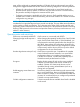
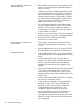
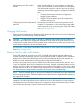
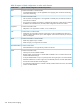
For information on the effect of the different QinQ modes on switch protocols and operations,see
Table Table 33 (page 338).
Effects of QinQ on other switch features
Per the IEEE standards, protocols such as STP and GVRP are assigned separate addresses for
customer networks and provider networks, ensuring that QinQ has no impact on their operations.
Bridge Protocol Data Units (BPDUs) that need to be tunneled through the provider network are
treated as normal multicast frames at the provider bridge and forwarded out.
However, other protocols use common addresses for both customer and provider networks, and
so are not supported when QinQ is enabled on the switch. Similarly, proprietary features such as
meshing, discovery, UDLD, and loop-protect do not provide tunneling support. In such cases, where
provider networks could run an instance of the same protocol as a customer could run local to their
site, these frames are dropped at the customer-network ports of the provider bridge.
NOTE: The IEEE standards group is devising new addressing schemes that may support additional
QinQ tunneling operations. Check the latest product release notes for implementation updates as
they apply to HP switches.
When QinQ is not enabled (the default setting), there are no impacts to the switch's normal
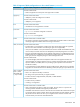
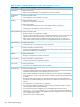
operations. The following table shows the impacts of QinQ on the operation of switch protocols
and features based on the QinQ mode that is configured as QinQ mixed VLAN mode (C-VLANs
and S-VLANs are allowed) or QinQ S-VLAN mode (S-VLANs only).
About QinQ 337