
Advanced Traffic Management Guide K/KA/KB.15.15
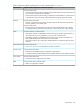



match/ignore statements in a class configuration, use
the resequence command.
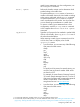
match | ignore Defines the classifier criteria used to determine which
packets belong to the traffic class.
If a packet matches a match criterion, it becomes a
member of the traffic class and is forwarded according
to the actions configured with the policy command.
If a packet matches an ignore criterion, no policy
action is performed on the packet. You can enter one
or more match/ignore statements in a traffic class.
To remove a match/ignore statement from a class
configuration, enter the no seq-number command
or the complete form of a no match or no ignore
command.
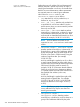
ip-protocol Specifies an IP protocol to be matched in packet fields
of IPv4 or IPv6 traffic, where ip-protocol is one of
the values described below.
When entering a match/ignore command in an IPv4
or IPv6 class, enter ? to display a list of valid
ip-protocol entries.
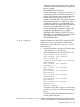
• In an IPv4 class, you can enter any of the following
IPv4 protocol match criteria:
ahesp
gre
icmp
1
igmp
1
ipip-in-ip
ipv6–in-ip
ospf
pim
sctptcp
1
udp
1
vrrp
To specify an IPv4 protocol as match criteria, you
can also enter its protocol number. Valid values
are from 0 to 255.
For example, 8 means Exterior Gateway Protocol;
121 means Simple Message Protocol. For a list of
IPv4 protocol numbers and corresponding protocol
names, see the IANA "Protocol Number
Assignment Services" at www.iana.com.
• In an IPv6 class, you can enter any of the following
IPv6 protocol match criteria:
ahesp
icmp
2
ipv6
sctptcp
2
udp
2
1. For IPv4 ICMP, IGMP, TCP, and UDP packets, you can enter additional match criteria.
2. For IPv6 ICMP, TCP, and UDP packets, you can enter additional match criteria; see:“Defining the ICMP match criteria”
(page 347), “Defining the IGMP match criteria” (page 349), “Defining TCP and UDP match criteria” (page 350).
Configuring a traffic class 343