
Advanced Traffic Management Guide K/KA/KB.15.15



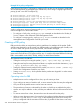
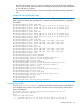
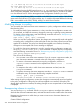

direction on a port or VLAN, and matches all
other IP traffic in the opposite direction.
For example, a Telnet connection requires TCP
traffic to move both ways between a host and
the target device. If you configure a match
statement for inbound Telnet traffic, policy actions
are normally applied to Telnet traffic in both
directions because responses to outbound
requests are also matched. However, if you enter
the established option, inbound Telnet traffic
arriving in response to outbound Telnet requests
is matched, but inbound Telnet traffic trying to
establish a connection is not matched.
tcp-flag tcp-flag ... (Optional) Applies only to TCP bit settings in
packets destined to a TCP destination port
configured as match criteria (with the
tcp-dest-port parameter) and can be one
or more of the following values:
ack Acknowledge matches TCP packets with the ACK flag.
fin Finish matches TCP packets with the FIN flag.
rst Reset matches TCP packets with the RST bit set.
syn Synchronized matches TCP packets with the SYN flag.
How IPv4 mask bit settings define a match (Example)
The following configuration exists:
• A match statement in a class configuration uses an IPv4 source-address/mask-length of
10.38.31.125/21. The mask-length of 21 results in an IPv4 mask of 0.0.7.255. In the second
octet of the mask, 7 means that the rightmost three bits are on or 1.
• The second octet of the corresponding source address is 31, which means that the rightmost
five bits are on or 1.
A match occurs when the second octet of the SA in a packet being classified has a value in the
range of 24 (binary 00011000) to 31 (binary 00001111), as shown in the last row in the following
table.
Table 34 How IPv4 mask defines a match
Bit position in the octetLocation of octet
1248163264128
11111000SA in match statement
11100000Mask for SA
0/10/10/111000Bits in the corresponding octet
of a packet's SA that must exactly
match
The shaded area indicates the bits in the packet that must exactly match the bits in the source IPv4 address in the
match/ignore statement.
• If a mask bit is 1 (wildcard value), the corresponding bits in a source/destination address in an IPv4 packet header
can be any value.
• If a mask bit is 0, the corresponding bits in a source/destination address must be the same value as in the IPv4
address in the match/ignore statement.
352 Classifier-based software configuration