
Advanced Traffic Management Guide K/KA/KB.15.15




A Spanning tree interoperability between HP and Cisco
switches
Introduction
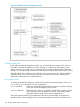
This appendix explains and provides step-by-step configuration instructions for implementing multiple
instance spanning-tree protocol (MSTP) and virtual router redundancy protocol (VRRP) on specific
HP and Cisco Catalyst switches. By combining both MSTP and VRRP you create a highly available
network with layer 2 and layer 3 redundancies and the ability to load-balance network traffic,
optimizing network performance. All HP and Cisco switches are configured for MSTP. VRRP is
configured on the HP 8200zl switches in the core.
Spanning Tree Protocol (STP) is a link management protocol that provides path redundancy while
preventing undesirable loops in the network. For an ethernet network to function properly, only
one active path can exist between two devices. Multiple Spanning Tree Protocol (MSTP) extends
STP and the Rapid Spanning Tree Protocol (RSTP) and is backwards compatible with both versions.
With MSTP, each spanning tree instance can include one or more VLANs. It applies a separate,
per-instance forwarding topology which uses RSTP for rapid convergence. When a port belongs
to multiple VLANs, it may be blocked in one spanning tree instance, but forwarding in another
instance. This provides multiple forwarding paths for data traffic and achieves load-balancing
across the network. In contrast to PVST, MSTP reduces the switch’s CPU load to a moderate level
by aggregating multiple VLANs in a single spanning tree instance. MSTP provides fast convergence
in the case of a switch, port, or link failure.
The Virtual Router Redundancy Protocol (VRRP) is designed to eliminate the single point of failure
inherent in an environment that uses statically configured default routes. VRRP specifies an election
protocol that dynamically assigns responsibility for a virtual router to one of the VRRP routers on
a LAN. The VRRP router controlling the IP address(es) associated with a virtual router is called the
Master, and forwards packets sent to these IP addresses. The election process provides dynamic
fail-over in the forwarding responsibility if the Master become unavailable. Any of the virtual router's
IP addresses on a LAN can then be used as the default first hop router by end-hosts. The advantage
gained from using VRRP is a higher availability default path without requiring configuration of
dynamic routing or router discovery protocols on every end-host.
When configured properly, this solution ensures that all redundant links are used and that the VRRP
routers can share default gateway duties. Combining MSTP and VRRP protocols into your network
design achieves a balanced, redundant, and highly available network solution.
HP to Cisco terminology
HP SwitchesCisco SwitchesDescription
untaggedaccess modeA port that belongs to a unique VLAN
and is untagged.
taggedtrunk modeA port that carries multiple VLANs
using 802.1q tags.
trunk-groupetherchannel or channel-groupAggregated links to support additional
bandwidth and link redundancy.
HP SwitchesCisco SwitchesConfiguration item
untaggedswitchport mode access switchport
access VLAN
untagged VLAN traffic
taggedswitchport trunk
encapsulationswitchport mode
trunkswitchport allowed VLAN
tagged VLAN traffic
trunk (trk)channel-groupaggregated links
378 Spanning tree interoperability between HP and Cisco switches