
Advanced Traffic Management Guide K/KA/KB.15.15
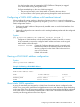
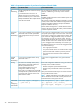
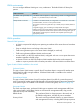
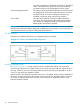
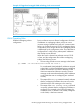
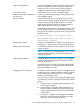

Table 2 Comparative operation of port based and protocol based VLANs
Protocol-Based VLANsPort-Based VLANsFunction
You can configure IP addresses on all protocol VLANs.
However, IP addressing is used only on IPv4 and IPv6
VLANs.
Usually configured with at least one unique
IP address.
A port-based VLAN can have no IP
address. However, this limits the switch
features available to ports on that VLAN.
IP
Addressing
Restrictions:
Loopback interfaces share the same IP address space with
VLAN configurations.Multiple IP addresses allow multiple subnets
within the same VLAN.
The maximum number of IP addresses supported on a switch
is 2048, which includes all IP addresses configured for both
VLANs and loopback interfaces (except for the default
loopback IP address 127.0.0.1).
Each IP address tconfigured on a VLAN interface must be
unique in the switch it cannot be used by a VLAN interface
or another loopback interface.
A port can be an untagged member of one protocol VLAN
of a specific protocol type, such as IPX or IPv6. If the same
A port can be a member of one untagged,
port-based VLAN. All other port-based
Untagged
VLAN
Membership protocol type is configured in multiple protocol VLANs, thenVLAN assignments for that port must be
tagged. a port can be an untagged member of only one of those.
For example, if you have two protocol VLANs, 100 and
200, and both include IPX, then a port can be an untagged
member of either VLAN 100 or VLAN 200, but not both
A port's untagged VLAN memberships can include up to
four different protocol types. It can be an untagged member
of one of the following:
• Four single-protocol VLANs
• Two protocol VLANs where one VLAN includes a single
protocol and the other includes up to three protocols
• One protocol VLAN where the VLAN includes four
protocols
A port can be a taggedmember of any protocol-based
VLAN.
A port can be a tagged member of any
port-based VLAN.
Tagged
VLAN
Membership
If the switch configuration enables IP routing, the switch can
internally route IPv4 traffic as follows:
The switch can internally route IP (IPv4)
traffic between port-based VLANs and
between port-based and IPv4
Routing
• Between multiple IPv4 protocol-based VLANs
protocol-based VLANs if the switch
configuration enables IP routing.
• Between IPv4 protocol-based VLANs and port-based
VLANs.
If the switch is not configured to route traffic
internally between port-based VLANs, then
Other protocol-based VLANs require an external router for
moving traffic between VLANs.
an external router must be used to move
traffic between VLANs.
NOTE: NETbeui and SNA are non-routable protocols. End
stations intended to receive traffic in these protocols must
be attached to the same physical network.
vlan vid protocol [ ipx | ipv4 | ipv6 |
arp | appletalk | sna | netbeui ]
vlan vid [ tagged | untagged [
e | port-list ]]
Commands
for
Configuring
Static VLANs
vlan vid [ tagged | untagged [ e | port-list
]]
42 Static Virtual LANs