
Advanced Traffic Management Guide K/KA/KB.15.15

VLAN environments
You can configure different VLAN types in any combination. The default VLAN will always be
present.
ElementsVLAN environment
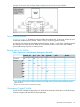
In the default VLAN configuration, all ports belong to VLAN 1 as untagged members.The default VLAN (port-based; VID
of 1) only
VLAN 1 is a port-based VLAN, for IPv4 traffic.
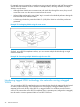
In addition to the default VLAN, the configuration can include one or more other
port-based VLANs, and one or more protocol VLANs.
Multiple VLAN environment
The switches covered in this guide allow up to 2048 (vids up to 4094) VLANs of
all types.
UsingVLAN tagging, ports can belong to multiple VLANs of all types.
Enabling routing on the switch enables it route IPv4 traffic between port-based VLANs
and between port-based VLANs and IPv4protocol VLANs. Routing other types of
traffic between VLANs requires an external router capable of processing the
appropriate protocols.
VLAN operation
General VLAN operation
• A VLAN is composed of multiple ports operating as members of the same subnet or broadcast
domain.
• Ports on multiple devices can belong to the same VLAN.
• Traffic moving between ports in the same VLAN is bridged (or switched).
• Traffic moving between different VLANs must be routed.
• A static VLAN is an 802.1Q-compliant VLAN, configured with one or more ports that remain
members regardless of traffic usage.
• A dynamic VLAN is an 802.1Q-compliant VLAN membership that the switch temporarily
creates on a port to provide a link to another port either in the same VLAN on another device.
Types of static VLANs available in the switch
Port-based VLANs
This type of static VLAN creates a specific layer-2 broadcast domain comprised of member ports
that bridge IPv4 traffic among themselves. Port-Based VLAN traffic is routable on the switches
covered in this guide.
Protocol-based VLANs
This type of static VLAN creates a layer-3 broadcast domain for traffic of a particular protocol,
and is composed of member ports that bridge traffic of the specified protocol type among themselves.
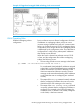
Some protocol types are routable on the switches covered in this guide; see Table 2 (page 42).
Designated VLANs
The switch uses these static, port-based VLAN types to separate switch management traffic from
other network traffic. While these VLANs are not limited to management traffic, they provide
improved security and availability.
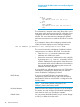
Default VLAN This port-based VLAN is always present in the switch and, in
the default configuration, includes all ports as members.
Primary VLAN The switch uses this port-based VLAN to run certain features
and management functions, including DHCP/Bootp responses
About static VLAN operation 43