
Advanced Traffic Management Guide K/KA/KB.15.15
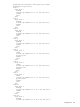
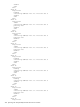
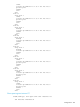
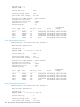
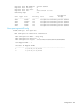


Approximate round trip times in milli-seconds:
Minimum = 0ms, Maximum = 988ms, Average = 68ms
Control-C
^C
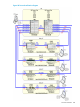
Simulate 8200 (core) failure test
This test simulates an 8200 chassis failure and validates network convergence recovery time.
1. Setup FTP server on 8200B on port A1. Setup FTP server on VLAN 1 with IP address 10.1.1.30.
2. Configure a port on one of the switches in IDF 1 for a VLAN (VLAN 3) on Instance 1.
3. Connect client to port with IP address 10.1.3.100 and gateway 10.1.3.1.
4. Start an FTP download on a large file (e.g. 800 Megabytes)
5. Shut down 8200A.
6. Log how much time between when the FTP transfer rate starts to decrease until transfer rate
starts to increase.
7. Repeat on VLAN for Instance 2.
8. Be sure to move FTP server to 8200A.
9. For Instance 2 VLAN 7 was used. The client was configured with IP 10.1.7.100 and gateway
10.1.7.1. Shut down 8200B.
Results
The transfer rate began to decrease quickly once 8200A lost power. After approximately 3 seconds
the transfer rate started to increase again and the FTP transfer was successful for both core failure
tests.
Conclusion
MSTP and VRRP provide an excellent, highly available network solution with layer 2 and layer 3
redundancies combined with the ability to load balance network traffic, optimizing network
performance. When configuring MSTP and VRRP, be sure to follow the configuration checklist.
Careful attention is required to correctly configure MSTP and VRRP; however, the benefits are worth
the effort. Fast convergence times are achieved if a link or switch failure occurs, ensuring maximum
network uptime.
Operating notes
802.1s MSTP on HP switches
The 802.1D STP and 802.1w RSTP spanning tree protocols operate without regard to a network’s
VLAN configuration, and maintain one common spanning tree throughout a bridged network.
Thus, these protocols map one loop-free, logical topology on a given physical topology. 802.1s
MSTP uses VLANs to create multiple spanning trees in a network, which significantly improves
network resource utilization while maintaining a loop-free environment.
While the per-VLAN spanning tree approach adopted by some vendors overcomes the network
utilization problems inherent in using STP or RSTP, using a per-VLAN technology with multiple
VLANs can overload the switch’s CPU. MSTP on the HP 8200zl switch complies with the IEEE
802.1s standard, and extends STP and RSTP functionality to map multiple independent spanning
tree instances onto a physical topology. With MSTP, each spanning tree instance can include one
or more VLANs and applies a separate, per-instance forwarding topology. Thus, where a port
belongs to multiple VLANs, it may be dynamically blocking in one spanning tree instance, but
forwarding in another instance. This achieves load-balancing across the network while keeping
the switch’s CPU load at a moderate level (by aggregating multiple VLANs in a single spanning
tree instance).
MSTP provides fault tolerance through rapid, automatic reconfiguration if there is a failure in a
network’s physical topology. With MSTP-capable switches, you can create a number of MST
regions containing multiple spanning tree instances. This requires the configuration of a number
Operating notes 449