
Advanced Traffic Management Guide K/KA/KB.15.15






2 GVRP
NOTE: All commands previously in the Summary of commands table are indexed under the entry
Command syntax.
Using GVRP
When GVRP is enabled on a switch, the VID for any static VLAN configured on the switch is
advertised, using BPDUs (Bridge Protocol Data Units), out all ports regardless of whether a port is
up or assigned to any particular VLAN. A GVRP-aware port on another device that receives the
advertisements over a link can dynamically join the advertised VLAN.
A dynamic VLAN (that is, a VLAN learned through GVRP) is tagged on the port on which it was
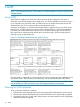
learned. Also, a GVRP-enabled port can forward an advertisement for a VLAN it learned about
from other ports on the same switch (internal source), but the forwarding port will not itself join
that VLAN until an advertisement for that VLAN is received through a link from another device
(external source) on that specific port.
Figure 11 Forwarding advertisements and dynamic joining
If a static VLAN is configured on at least one port of a switch, and that port has established a link
with another device, then all other ports of that switch will send advertisements for that VLAN.
NOTE: A port can learn of a dynamic VLAN through devices that are not aware of GVRP. VLANs
must be disabled in GVRP-unaware devices to allow tagged packets to pass through.
Planning for GVRP operation
To set up dynamic VLANs for a segment:
1. Determine the VLAN topology required for each segment (broadcast domain) on the network.
2. Determine the VLANs that must be static and the VLANs that can be dynamically propagated.
3. Determine the devices on which static VLANs must be manually created in order to propagate
VLANs throughout the segment.
66 GVRP