
Advanced Traffic Management Guide K/KA/KB.15.15

GVRP uses GVRP BPDUs (GVRP Bridge Protocol Data Units) to advertise static VLANs, and in this
guide a GVRP BPDU is termed an advertisement. On a switch, advertisements are sent outbound
from ports to the devices directly connected to those ports.
GVRP operating notes
• A dynamic VLAN must be converted to a static VLAN before it can have an IP address.
• On the switches covered in this guide, GVRP can be enabled only if max vlans is set to no
more than 256 VLANs.
• The total number of VLANs on the switch (static and dynamic combined) cannot exceed the
current Maximum VLANs setting. For example, in the factory default state, the switch supports
up to 256 VLANs. Any additional VLANs advertised to the switch will not be added unless
you first increase the Maximum VLANs setting. In the Menu interface, click on 2. Switch
Configuration … | 8. VLAN Menu | 1. VLAN Support. In the global config level of the CLI,
use max-vlans.
• Converting a dynamic VLAN to a static VLAN and then executing the write memory
command saves the VLAN in the startup-config file and makes it a permanent part of the
switch's VLAN configuration.
• Within the same broadcast domain, a dynamic VLAN can pass through a device that is not
GVRP-aware. This is because a half-duplex repeater or a switch that is not GVRP-aware will
flood the GVRP (multicast) advertisement packets out all ports.
• Rebooting a switch on which adynamic VLAN exists deletes that VLAN. However, the dynamic
VLAN reappears after the reboot if GVRP is enabled and the switch again receives
advertisements for that VLAN through a port configured to add dynamic VLANs.
• By receiving advertisements from other devices running GVRP, the switch learns of static VLANs
on those other devices and dynamically (automatically) creates tagged VLANs on the links to
the advertising devices. Similarly, the switch advertises its static VLANs to other GVRP-aware
devices, as well as the dynamic VLANs the switch has learned.
• A GVRP-enabled switch does not advertise any GVRP-learned VLANs out of the ports on which
it originally learned of those VLANs.
• While GVRP is enabled on the switch, you cannot apply any ACLs to VLANs configured on
the same switch.
• GVRP (GARP VLAN Registration Protocol) is an application of GARP (Generic Attribute
Registration Protocol.) It is defined in the IEEE 802.1Q standard, and GARP is defined in the
IEEE 802.1D-1998 standard.
• GVRP cannot run concurrently with RPVST+.
Example of GVRP operation
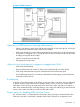
In the following example, Tagged VLAN ports on switch A and switch C advertise VLANs 22 and
33 to ports on other GVRP-enabled switches that can dynamically join the VLANs.
72 GVRP