
Advanced Traffic Management Guide K/KA/KB.15.15
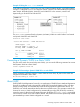
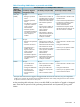


unknown VLANs, then the VLAN is dynamically created and the port becomes a tagged member
of the VLAN.
Example 56 GVRP unknown VLAN settings
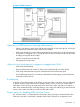
Suppose that in Example 55 (page 73), port 1 on switch A is connected to port 5 on switch C.
Because switch A has VLAN 22 statically configured, while switch C does not have this VLAN
statically configured (and does not "Forbid" VLAN 22 on port 5), VLAN 22 is handled as an
"Unknown VLAN" on port 5 in switch C. Conversely, if VLAN 22 was statically configured on
switch C, but port 5 was not a member, port 5 would become a member when advertisements for
VLAN 22 were received from switch A.
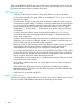
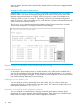
The CLI show gvrp command and the menu interface VLAN Support screen show a switch's
current GVRP configuration, including the Unknown VLAN settings.
Per-port options for dynamic VLAN advertising and joining
Initiating advertisements
As described in the preceding section, to enable dynamic joins, GVRP must be enabled and a
port must be configured to Learn (the default). However, to send advertisements in your network,
one or more static (tagged, untagged, or auto) VLANs must be configured on one or more switches
(with GVRP enabled), depending on your topology.
Enabling a port for dynamic joins
You can configure a port to dynamically join a static VLAN. The join will occur if that port
subsequently receives an advertisement for the static VLAN. This is done by using the Auto and
Learn options described in Table 8 (page 75).
Parameters for controlling VLAN propagation behavior
You can configure an individual port to actively or passively participate in dynamic VLAN
propagation or to ignore dynamic VLAN (GVRP) operation. These options are controlled by the
GVRP "Unknown VLAN" and the static VLAN configuration parameters.
74 GVRP