
HP Power over Ethernet (PoE/PoE+) Planning and Implementation Guide



12-9
Planning and Implementation for the HP 3800-PoE+ Switches
Planning the PoE+ Configuration
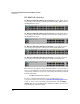
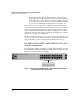
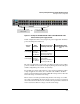
Figure 12-3. Example of a HP 3800-48G-PoE+-4SFP+ or HP 3800-48G-PoE+-4XG
Switch with one power supply installed
In this configuration there is no backup if the power supply fails. All switch
power and PoE power will be lost.
The lowest loaded bank of ports (1-24 or 25-48) has 22 watts reserved. That
power is available for use by the two highest priority ports in the bank, (in a
default configuration ports 1 and 2, or 25 and 26).
For example, the switch starts with 700 or 1000 watts. Depending on which
voltage is applied to the switch, 110 or 220. The switch will use 185 W for
switch operation. This drops the usable PoE/PoE+ wattage down to either 515
W for 110 voltage or 815 W for 220 voltage.
Then it reserves 22 watts per bank leaving 471 W at 110 voltage or 771 W at
220 voltage for PoE/PoE+ allocation. If ports 1-24 are chosen to be used then
the 22 watts that was held in reserve for that bank of ports will be added back
in for a total of 493 W at 110 voltage or 793 W at 220 voltage.
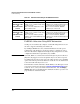
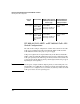
Up to 17 ports can supply 30
watts of PoE+
or
33 ports can supply up to 15.4
watts of PoE power
Source of
Power
Watts
Available
Number of Ports Powered
and Average watts/Port
Redundant Number of Ports
Powered and Average watts/
Port
One 1000 watt
Power Supply
185 W for
system use,
and 515 W for
PoE+ @ 110 V
17 @ average 30 W each for
a total of 510 W
33 @ average 15.4 W each
48 @ average 7.5 W each
None
One 1000 watt
Power Supply
185 W for
system use,
and 815 W for
PoE+ @ 220 V
27 @ average 30 W each for
a total of 720 W
48 @ average 15.4 W each
48 @ average 7.5 W each
None