
Multicast and Routing Guide K/KA/KB.15.15
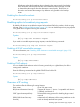
HP software makes the forwarding decision based on the routing switch's knowledge
of the destination network prefix. Routers cannot determine that a message is unicast
or directed broadcast apart from the destination network prefix. The decision to
forward or not forward the message is by definition only possible in the last-hop
router.
Disabling the directed broadcasts
HP Switch(config)# no ip directed-broadcast
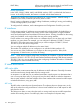
Disabling replies to broadcast ping requests
By default, HP devices are enabled to respond to broadcast ICMP echo packets, which are ping
requests. (See “Disabling ICMP messages” (page 120). You can disable response to ping requests
on a global basis using the following CLI command:
HP Switch(config)# no ip icmp echo broadcast-request
Syntax:
[no] ip icmp echo broadcast-request
If you need to re-enable response to ping requests, enter the following command:
HP Switch(config)# ip icmp echo broadcast-request
Disabling all ICMP unreachable messages
For more information, see “Disabling ICMP destination unreachable messages” (page 121).
HP Switch(config)# no ip icmp unreachable
Syntax:
[no] ip icmp unreachable
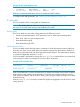
Disabling ICMP redirects
You can disable ICMP redirects on the HP routing switch only on a global basis, for all the
routing-switch interfaces.
Enter the following command at the global CONFIG level of the CLI:
HP Switch(config)# no ip icmp redirects
Syntax:
[no] ip icmp redirects
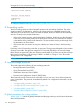
Overview of IP routing
The switches offer the following IP routing features:
Static routes Up to 256 static routes
RIP (Router Information Protocol) Supports RIP Version 1, Version 1 compatible with Version
2 (default), and Version 2
OSPF (open shortest path first) The standard routing protocol for handling larger routed
networks
IRDP (ICMP Router Discovery
Protocol)
Advertises the IP addresses of the routing interfaces on this
switch to directly attached host systems
Disabling replies to broadcast ping requests 111