
Multicast and Routing Guide K/KA/KB.15.15
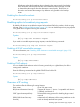
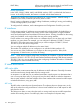
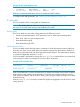
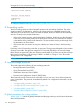
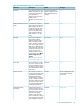
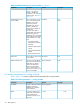
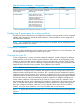
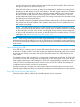
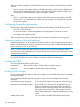

Table 8 IP global parameters for routing switches
See pageDefaultDescriptionParameter
117The lowest-numbered IP
address configured on the
The value that routers use to
identify themselves to other
Router ID
lowest-numbered routing
interface.
routers when exchanging
route information.
OSPF uses the router ID to
identify routers.
RIP does not use the router
ID.
118EnabledA standard IP mechanism
that routers use to learn the
Address Resolution Protocol
(ARP)
MAC address of a device
on the network. The router
sends the IP address of a
device in the ARP request
and receives the device's
MAC address in an ARP
reply.
N/AFive minutes.The amount of time the
device keeps a MAC
ARP age
address learned through
ARP in the device's ARP
cache. The device resets the
timer to zero each time the
ARP entry is refreshed and
removes the entry if the timer
reaches the ARP age. (Can
be set using the menu
interface to be as long as
1440 minutes. Go to Menu
Switch Configuration IP
Config.)
See “Increasing ARP age
timeout (CLI)” (page 107).
119DisabledAn IP mechanism a router
can use to answer an ARP
Proxy ARP
request on behalf of a host,
by replying with the router's
own MAC address instead
of the host's.
See the Management and
Configuration Guide for
your switch.
64 hopsThe maximum number of
routers (hops) through which
a packet can pass before
Time to Live (TTL)
being discarded. Each
router decreases a packet's
TTL by 1 before forwarding
the packet. If decreasing the
TTL causes the TTL to be 0,
the router drops the packet
instead of forwarding it.
(page 120)DisabledA directed broadcast is a
packet containing all ones
Directed broadcast
forwarding
(or in some cases, all zeros)
in the host portion of the
destination IP address.
When a router forwards
such a broadcast, it sends a
copy of the packet out each
of its enabled IP interfaces.
IP route exchange protocols 115