
Multicast and Routing Guide K/KA/KB.15.15

Viewing RIP redistribution information
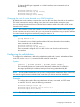
To display RIP redistribution information, enter the show ip rip redistribute command at
any context level:
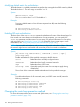
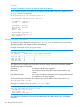
Example 74 Example of show IP rip redistribute output
HP Switch# show ip rip redistribute
RIP redistributing
Route type Status
--------- ------
connected enabled
static disabled
ospf disabled
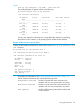
RIP automatically redistributes connected routes that are configured on interfaces that are running
RIP and all routes that are learned via RIP. The router rip redistribute command (page 131),
configures the routing switch to cause RIP to advertise connected routes that are not running RIP,
static routes, and OSPF routes. The display shows whether RIP redistribution is enabled or disabled
for connected, static, and OSPF routes.
Viewing RIP redistribution filter (restrict) information
To display RIP restrict filter information, enter the show ip rip restrict command at any
context level:
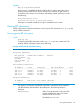
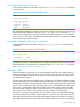
Example 75 Example of show IP rip restrict output
HP Switch# show ip rip restrict
RIP restrict list
IP Address Mask
--------------- ------------
The display shows if any routes identified by the IP Address and Mask fields are being restricted
from redistribution. The restrict filters are configured by the router rip restrict command.
(See “Configuring for redistribution” (page 131).)
Overview of RIP
Routing Information Protocol (RIP) is an IP route exchange protocol that uses a distance vector (a
number representing distance) to measure the cost of a given route. The cost is a distance vector
because the cost often is equivalent to the number of router hops between the HP routing switch
and the destination network.
An HP routing switch can receive multiple paths to a destination. The software evaluates the paths,
selects the best path, and saves the path in the IP route table as the route to the destination. Typically,
the best path is the path with the fewest hops. A hop is another router through which packets must
travel to reach the destination. If the HP routing switch receives an RIP update from another router
that contains a path with fewer hops than the path stored in the HP routing switch's route table,
the routing switch replaces the older route with the newer one. The routing switch then includes
the new path in the updates it sends to other RIP routers, including HP routing switches.
RIP routers, including HP routing switches, also can modify a route's cost, generally by adding to
it, to bias the selection of a route for a given destination. In this case, the actual number of router
hops may be the same, but the route has an administratively higher cost and is thus less likely to
be used than other, lower-cost routes. A RIP route can have a maximum cost of 15. Any destination
Overview of RIP 137