
Multicast and Routing Guide K/KA/KB.15.15
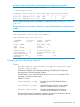

Used to configure MD5 authentication in the router OSPF context on both ABRs in
a virtual link. The MD5 authentication takes effect immediately, and all OSPF packets
transmitted on the link contain the designated key. Every OSPF packet received on
the interface for the virtual link on each ABR is checked for the key. If it is not present,
the packet is dropped.
To disable MD5 authentication on an ABR interface used for a virtual link, use the
no form of the command. The password must be the same on both ABRs on a given
virtual link.
NOTE: Before using this authentication option, you must configure one or more
key chains on the routing switch by using the Key Management System (KMS). See
the Access Security Guide for your routing switch.
ip-address For an ABR in a given virtual link, this is the IP address
used to create the link on that ABR. (This IP address
matches the IP address of the interface on the opposite
end of the virtual link. See the description of
ip-addressin the syntax description under
“Configuring a virtual link” (page 159).)
chain-name-string The name of a key generated using the key-chain
chain_name key key_id command.
To change the MD5 authentication configured on a
virtual link, re-execute the command with the new MD5
key.
NOTE: To replace the MD5 method with the password method on a virtual link,
overwrite the MD5 configuration by using the password form of the command
shown under “Authenticating the OSPF password on a virtual link” (page 163). (It
is not necessary to disable the currently configured OSPF MD5 authentication.)
Default: Disabled
Configuring a passive OSPF interface
For more information, see “About OSPF passive” (page 203).
Enter this command in VLAN context:
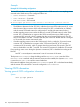
HP Switch(vlan-1)# ip ospf passive
Syntax:
[no] ip ospf ip-addr passive
Configures passive OSPF for an AS.
ip-addr Optionally, you can configure an IP address on the VLAN.
The no option disables the passive option; the interface becomes an active interface.
Default: Active
Example
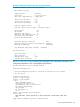
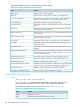
To display the OSPF passive information, enter the command shown in Figure A-14:
164 Open Shortest Path First Protocol (OSPF)