
Multicast and Routing Guide K/KA/KB.15.15
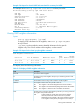
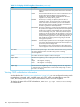
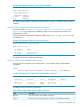
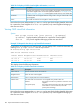
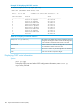
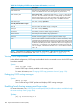
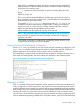
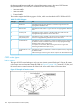

Table 26 CLI display of OSPF route and status information (continued)
DescriptionField
The metric for any default route we injected into a stub area if the routing
switch is an ABR for the area. This value applies only to stub areas.
Stub Default Cost
send or don't send — indicates the state of the no-summary option for the
stub area. The value indicates if the area is "totally stubby" (no summaries
Stub Summary LSA
sent from other areas) or just "stub" (summaries sent.) Applies only to stub
areas and takes effect only if the routing switch is the ABR for the area.
This value is always ospf metric.Stub Metric Type
Currently defined address ranges:
The area where the address range is configured.Area ID
This value is always Summary.LSA Type
The address part of the address range specification.IP Network
The mask part of the address range specification.Network Mask
Whether advertising (yes) or suppressing (no) this address range.Advertise
The cost of the interface connection between one switch and another, which
is determined by the bandwidth in mega bits per second. The OSPF protocol
Cost
determines the interface connection cost of each neighbor and uses these costs
to determine the best path to reach a destination. The cost can range from a
minimum of 1 to a maximum of 10. The faster the connection, the lower the
cost. For example, a fast Ethernet interface cost is 1 and a Ethernet interface
cost is 10.
NOTE: The remaining interface and virtual link information is the same as for the previously
described OSPF show commands. See Table 16 (page 171) and Table 17 (page 172).
Viewing OSPF traps enabled
In the default configuration, OSPF traps are disabled. Use this command to view which OSPF traps
have been enabled.
Syntax:
show ip ospf traps
Lists the OSPF traps currently enabled on the routing switch.
For more information, see “Changing OSPF trap generation choices” (page 154).
Debugging OSFP routing messages
Syntax:
debug ip ospf
Turns on the tracing of OSPF packets and displays OSPF routing messages.
Enabling load sharing among next-hop routes
For more information, see “OSPF equal-cost multipath (ECMP) for different subnets available through
the same next-hop routes” (page 204).
Syntax:
[no] ip load-sharing 2-4
188 Open Shortest Path First Protocol (OSPF)