
Multicast and Routing Guide K/KA/KB.15.15
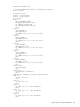
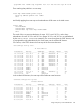
10.2.23.0/24 VLAN23 23 connected 1 0
10.2.29.0/24 10.2.21.1 21 rip 2 120
10.3.31.0/24 10.2.21.1 21 rip 2 120
10.3.33.0/24 10.2.21.1 21 rip 2 120
10.3.37.0/24 10.2.21.1 21 rip 2 120
127.0.0.0/8 reject static 0 0
127.0.0.1/32 lo0 connected 1 0
With this configuration, the routers and host computers in each routing domain are able to
communicate with all other routers and hosts in that domain. In addition, the routers and hosts in
the RIP domains can communicate with all interfaces of the adjacent border router and with hosts
attached to those interfaces. (To prevent that cross-domain communication, you would remove the
redistribute connected command from the router rip context.) Beyond those connected
routes on the RIP side, there is no inter-domain communication.
Thus, host Z can ping host X and host L, but not host M or host B. And host M can ping host L, but
not host X or host Y or host A. And so on.
Basic inter-domain protocol redistribution
Route redistribution allows border routers to distribute routes between adjacent routing domains.
Thus, the North router can redistribute routes from the northern RIP domain to the OSPF domain
and from the OSPF domain to the northern RIP domain. Similarly, the South router can redistribute
routes from the southern RIP domain to the OSPF domain and from the OSPF domain to the southern
RIP domain. And if both the North and South routers have redistribution enabled in both directions
at the same time, the routes that are redistributed from the RIP domains to the OSPF domain will
be further distributed to the opposite RIP domain, and routers and hosts in all domains will be able
to communicate with each other. (Some subtle complications are explained below.)
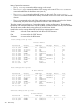
For example, in the North and South routers you might add a redistribute rip command to
the router ospf context and a redistribute ospf command to the router rip context,
like this:
.
.
router ospf
area backbone
redistribute rip
exit
router rip
redistribute connected
redistribute ospf
exit
.
.
This causes extensive redistribution of routes within all three routing domains, adding a large
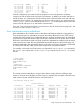
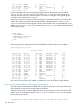
number of routes to the route tables of all the routers. For example, the route table in the East router
adds routes to subnets in both RIP domains, and looks like this:
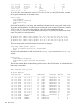
East(config)# show ip route
IP Route Entries
Destination Gateway VLAN Type Sub-Type Metric Dist.
--------------- --------------- ---- --------- ---------- ---------- -----
10.1.11.0/24 10.3.32.1 32 ospf External2 10 110
10.1.12.0/24 10.3.32.1 32 ospf External2 10 110
10.1.13.0/24 10.3.32.1 32 ospf External2 10 110
10.1.14.0/24 10.3.32.1 32 ospf External2 10 110
10.2.22.0/24 10.3.33.2 33 ospf External2 10 110
10.2.23.0/24 10.3.33.2 33 ospf External2 10 110
10.3.31.0/24 10.3.32.1 32 ospf IntraArea 2 110
10.3.31.0/24 10.3.33.2 33 ospf IntraArea 2 110
10.3.32.0/24 VLAN32 32 connected 1 0
Using route policy in route redistribution 217