
Multicast and Routing Guide K/KA/KB.15.15

querier. If you need to disable the querier feature, do so through the IGMP configuration MIB, see
“Configuring the querier function” (page 19).
NOTE: IGMP configuration on the switches operates at the VLAN context level. If you are not
using VLANs, configure IGMP in VLAN 1 (the default VLAN) context.
Enhancements
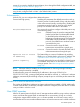
With the CLI, you can configure these additional options:
Forward with high priority Disabling this parameter (the default) causes the switch or
VLAN to process IP multicast traffic, along with other traffic,
in the order received (usually, normal priority.) Enabling this
parameter causes the switch or VLAN to give a higher
priority to IP multicast traffic than to other traffic.
Auto/blocked/forward You can use the console to configure individual ports to any
of the following states:
Auto (Default) Causes the switch to interpret IGMP
packets and to filter IP multicast traffic based
on the IGMP packet information for ports
belonging to a multicast group. This means that
IGMP traffic will be forwarded on a specific
port only if an IGMP host or multicast router is
connected to the port.
Blocked Causes the switch to drop all IGMP
transmissions received from a specific port.
Forward Causes the switch to forward all IGMP and IP
multicast transmissions through the port.
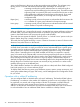
Operation with or without
IP addressing
This feature helps to conserve IP addresses by enabling
IGMP to run on VLANs that do not have an IP address. See
“Operation with or without IP addressing” (page 26).
Querier capability The switch performs this function for IGMP on VLANs having
an IP address when there is no other device in the VLAN
acting as querier. See “About using the switch as querier”
(page 34).
NOTE: Whenever IGMP is enabled, the switch generates an Event Log message indicating
whether querier functionality is enabled.
IP multicast traffic groups are identified by IP addresses in the range of 224.0.0.0 to
239.255.255.255. Also, incoming IGMP packets intended for reserved, or "well-known" multicast
addresses, automatically flood through all ports (except the port on which the packets entered the
switch.)
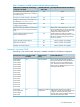
Number of IP multicast addresses allowed
The number of IGMP filters (addresses) and static multicast filters available is 2,038. Additionally,
16 static multicast filters are allowed, If multiple VLANs are configured, then each filter is counted
once per VLAN in which it is used.
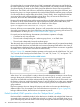
How IGMP operates
IGMP is an internal protocol of the IP suite. IP manages multicast traffic by using switches, multicast
routers, and hosts that support IGMP. A multicastrouter is not necessary as long as a switch is
configured to support IGMP with the querier feature enabled. A set of hosts, routers, and/or
switches that send or receive multicast data streams to or from the same sources is called a multicast
How IGMP operates 25