
Multicast and Routing Guide K/KA/KB.15.15
• RFC1997: BGP Communities Attribute
• RFC2796: BGP Route Reflection
• RFC4724: Graceful Restart Mechanism for BGP
BGP extensions
Route reflection
By design, IBGP peers do not advertise iBGP routes to other iBGP peers. In order for iBGP peers
to learn all the routes within the autonomous system as well as all the external routes, the iBGP
peers would have to be fully meshed. This means for n iBGP peers there would have to be n*(n-1)/2
iBGP sessions. In a large autonomous system network configuration would become an issue.
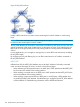
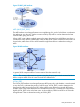
Route Reflection is one of the alternate solutions to alleviate this problem. In the BGP network, one
of the iBGP speakers is designated as the route reflector. The route reflector advertises the routes
it learns to other iBGP peers.
In a route reflector configuration the other iBGP peers are classified as clientpeers and non-client
peers.
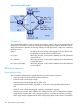
The action taken by the route reflector (after determining the best route) depends on whether the
best route was received from a client peer or a non-client peer. If the route was received from a
client peer, the route reflector will reflect that route to all the client peers and non-client peers.
If the route was received from a non-client peer, then the route is advertised to all its configured
clients.
Route reflection introduces two new discretionary attributes: Originator ID and Cluster List, which
are used in determining the best path as defined in “BGP route selection” (page 306).
In an Autonomous System more than one route reflector can be configured.
BGP graceful restart (GR)
When a BGP speaker shuts down, planned or unplanned, the routes that are advertised by the
speaker and reachable via the speaker now become unreachable. Upon detecting that the BGP
speaker has restarted, the peers delete the routes and re-add them when the restarting router
advertises them again. This results in route-flap across the BGP connectivity and impacts multiple
routing domains causing transient instability in the network.
The Graceful Restart capability is supported as a 'helper router` on the HP 3500, 5400, and 8200
product series. In 'helper only' mode the router helps the other restarting router by holding the
received routes from it as stale routes and not dropping them.
On the HP 8200 product series, the Graceful Restart capability is supported as a restarting router
in non-stop routing mode.
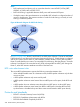
1. To establish a BGP session with a peer, a BGP GR Restarter sends an OPEN message with
GR capability to the peer.
2. Upon receipt of this message, the peer is aware that the sending router is capable of Graceful
Restart, and sends an OPEN message with GR Capability to the GR Restarter to establish a
GR session. If neither party has the GR capability, the session established between them will
not be GR capable.
3. The GR session between the GR Restarter and its peer goes down when the GR Restarter
restarts BGP. The GR capable peer will mark all routes associated with the GR Restarter as
stale. However, during the configured GR Time, it still uses these routes for packet forwarding.
4. After the restart, the GR Restarter will reestablish a GR session with its peer and send a new
GR message notifying the completion of restart. Routing information is exchanged between
them for the GR Restarter to create a new routing table and forwarding table with stale routing
information removed. Then the BGP routing convergence is complete.
BGP extensions 309