
Multicast and Routing Guide K/KA/KB.15.15
• Static routes
• Directly connected interfaces
VLAN interface support The MRT supports up to 128 outbound
VLANs at any given time. The sum of all
outbound VLANs across all current flows on
a router may not exceed 128. (A single flow
may span one inbound VLAN and up to 128
outbound VLANs, depending on the VLAN
memberships of the hosts actively belonging
to the flow.)
Flow capacity Up to 2048 flows are supported in hardware
across a maximum of 128 outbound VLANs.
(A flow is composed of an IP source address
and an IP multicast group address,
regardless of the number of active hosts
belonging to the multicast group at any given
time.)
IGMP compatibility PIM-DM is compatible with IGMP (V1 to V3)
and is fully interoperable with IGMP for
determining multicast flows.
VRRP PIM-DM is fully interoperable with VRRP to
quickly transition multicast routes in the event
of a failover.
MIB support With some exceptions, PIM-DM supports the
parts of the multicast routing MIB applicable
to PIM-DM operation.
PIM draft specifications Compatible with PIM-DM draft specifications
(V1 and V2.)
PIM-DM operation
PIM-DM operates at the router level to direct traffic for a particular multicast group along the most
efficient path to the VLANs which have hosts that have joined that group. A unicast source address
and a multicast group address comprise a given source/group (S/G) pair. Multicast traffic moving
from a source to a multicast group address creates a flow to the area(s) of the network requiring
the traffic. The flow destination is the multicast group address and not a specific host or VLAN. A
single multicast flow has one source and one multicast group address (destination), but may reach
many hosts in different subnets, depending on which hosts have issued joins for the same multicast
group.
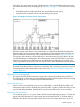
PIM routes the multicast traffic for a particular S/G pair on paths between the source unicast
address and the VLANs where it is requested (by joins from hosts connected to those VLANs.)
Physical destinations for a particular multicast group can be hosts in different VLANs or networks.
Individual hosts use IGMP configured per-VLAN to send joins requesting membership in a particular
multicast group. All hosts that have joined a given multicast group (defined by a multicast address)
remain in that group as long as they continue to issue periodic joins.
PIM-DM interoperates with IGMP and the switch's routing protocols for the switches covered by
this guide. The PIM operates independently of the routing protocol you choose to run on your
switches. This means that you can use PIM-DM with RIP, OSPF, or static routes configured. PIM-DM
uses a unicast routing table to find the path to the originator of the multicast traffic and sets up
multicast trees for distributing multicast traffic. This routing method is known as reverse path
forwarding (RPF.)
56 PIM-DM (Dense Mode)