
Multicast and Routing Guide K/KA/KB.15.15
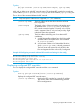

router pim bsr-candidate
Disables or re-enables the router for advertising itself as a Candidate-BSR on the
VLAN interface specified by source-ip-vlan [vid]. This command is used to
disable and re-enable BSR candidate operation after the bsr-candidate
source-ip-vlan [vid] command has been used to enable C-BSR operation
on the router. (This command operates only after the BSR source-ip-VLAN ID
has been configured.)
(Default: Disabled)
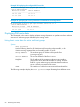
Changing the priority setting
Changing the priority setting for a BSR-candidate router.
Syntax:
bsr-candidate priority [0-255]
[no] router pim bsr-candidate priority [0-255]
Specifies the priority to apply to the router when a BSR election process occurs in
the PIM-SM domain. The candidate with the highest priority becomes the BSR for
the domain. If the highest priority is shared by multiple routers, the candidate having
the highest IP address becomes the domain's BSR. Zero (0) is the lowest priority.
To make BSR selection easily predictable, use this command to assign a different
priority to each candidate BSR in the PIM-SM domain.
(Default: 0; Range 0–255)
NOTE: Disabling PIM-SM on the elected BSR or disabling the C-BSR functionality
on the elected BSR causes the router to send a Bootstrap Message (BSM) with a
priority setting of 0 to trigger a new BSR election. If all BSRs in the domain are set
to the default priority (0), the election will fail because the result is to re-elect the
BSR that has become unavailable. For this reason, it is recommended that all C-BSRs
in the domain be configured with a bsr-candidate priority greater than 0.
Changing the distribution
Changing the distribution of multicast groups across a domain.
Syntax:
bsr-candidate hash-mask-length [1-32]
[no] router pim bsr-candidate hash-mask-length [1-32]
Controls distribution of multicast groups among the C-RPs in a domain where there
is overlapping coverage of the groups among the RPs. This value specifies the length
(number of significant bits) taken into account when allocating this distribution. A
longer hash-mask-length results in fewer multicast groups in each block of
group addresses assigned to the various RPs. Because multiple blocks of addresses
are typically assigned to each C-RP, this results in a wider dispersal of addresses
and enhances load-sharing of the multicast traffic of different groups being used in
the domain at the same time.
(Default: 30; Range 1–32)
Changing the message interval
Changing the BSR message interval.
Syntax:
bsr-candidate bsm-interval [5-300]
72 PIM-SM (Sparse Mode)