
Multicast and Routing Guide K/KA/KB.15.15

Protocol Independent Multicast (PIM) is a family of routing protocols that form multicast trees to
forward traffic from multicast sources to subnets that have used a protocol such as IGMP to request
the traffic. PIM relies on the unicast routing tables created by any of several unicast routing protocols
to identify the path back to a multicast source (reverse path forwarding, or RPF.) With this
information, PIM sets up the distribution tree for the multicast traffic. The PIM-DM and PIM-SM
protocols on the switches covered in this guide enable and control multicast traffic routing.
IGMP provides the multicast traffic link between a host and a multicast router running PIM-SM.
Both PIM-SM and IGMP must be enabled on VLANs whose member ports have directly connected
hosts with a valid need to join multicast groups.
PIM-DM is used in networks where, at any given time, multicast group members exist in relatively
large numbers and are present in most subnets. However, using PIM-DM in networks where multicast
sources and group members are sparsely distributed over a wide area can result in unnecessary
multicast traffic on routers outside the distribution paths needed for traffic between a given multicast
source and the hosts belonging to the multicast group. In such networks, PIM-SM can be used to
reduce the effect of multicast traffic flows in network areas where they are not needed. And because
PIM-SM does not automatically flood traffic, it is a logical choice in lower bandwidth situations.
License requirements:
In the 3500yl and 5400zl switches, PIM-SM is included with the Premium License. In the 6200yl
and 8200zl switches, this feature is included with the base feature set.
PIM-SM features
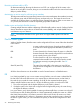
PIM-SM on the switches covered in this guide include:
Routing protocol support PIM uses whichever IP unicast routing protocol is running
on the router. These can include:
• RIP
• OSPF
• Static routes
• Directly connected interfaces
VLAN interface support: Up to 127 outbound VLANs (and 1 inbound VLAN) are
supported in the multicast routing table (MRT) at any given
time. This means the sum of all outbound VLANs across all
current flows on a router may not exceed 127. (A single
flow may span one inbound VLAN and up to 127 outbound
VLANs, depending on the VLAN memberships of the hosts
actively belonging to the flow.)
Flow capacity: Up to 2048 flows are supported in hardware across a
maximum of 128 VLANs. (A flow is composed of an IP
source address and an IP multicast group address,
regardless of the number of active hosts belonging to the
multicast group at any given time.)
Multicast group to RP mapping: PIM-SM uses the BSR protocol to automatically resolve
multicast group addresses to C-RP routers. In the current
software release, a router administers BSR operation on a
PIM-SM domain basis. (BSR zones and PIM border router
operation are not currently supported by the switches
covered in this guide.) Note that BSR operation does not
extend to statically configured RPs.
IGMP compatibility: PIM-SM is compatible with IGMP version 2, and is fully
interoperable with IGMP for determining multicast flows.
PIM-SM features 93