
Multicast and Routing Guide K/KA/KB.15.15

If it is necessary to prevent a router from operating as a DR on a given VLAN, disable DR operation
by configuring the DR priority as zero (0.)
BSR
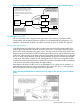
Before a DR can forward encapsulated packets for a specific multicast group to an RP, it must know
which router in the domain is the elected RP for that multicast group. The BSR function enables this
operation by doing the following:
1. Learns the group-to-RP mappings on the C-RPs in the domain by reading the periodic
advertisements each one sends to the BSR.
2. Distributes the aggregate C-RP information as an RP-set to the PIM-SM routers in the domain.
This is followed by an election to assign a specific multicast group or range of groups to the
C-RPs in the domain. (The software supports assignment of up to four multicast addresses
and/or ranges of multicast addresses to a C-RP.)
The BSR periodically sends bootstrap messages to the other PIM-SM routers in the domain to
maintain and update the RP-set data throughout the domain, and to maintain its status as the elected
BSR.
NOTE: Where static RPs are configured in the domain to support the same multicast group(s) as
one or more (dynamic) C-RPs, then the RP-set data has the precedence for assigning RPs for these
groups unless the static RPs have been configured with the override option and if the multicast
group mask for the static RP equals or exceeds the same mask for the applicable C-RP(s.)
BSR configuration and election
There should be multiple BSR candidates configured in a PIM-SM domain so that if the elected BSR
becomes unavailable, another router will take its place. In the BSR election process, the BSR
candidate configured with the highest priority number is selected. Where the highest priority setting
is shared by multiple candidates, the candidate having the highest IP address is selected. In the
event that the selected BSR subsequently fails, another election takes place among the remaining
BSR candidates. To facilitate a predictable BSR election, configure a higher priority on the router
you want elected as the BSR for the domain.
NOTE: A router serving as the BSR for a domain should be central to the network topology. This
helps to ensure optimal performance and also reduce the possibility of a network problem isolating
the BSR.
BSR role in fault recovery
If the hold-time maintained in the BSR for a given C-RP's latest advertisement expires before being
refreshed by a new advertisement from the C-RP, the non-reporting C-RP is removed from the
domain. In this case, the removed C-RP's multicast groups are re-assigned to other C-RPs. (If no
other C-RPs or static RPs in the domain are configured to support a multicast group from the
non-reporting C-RP, that group becomes unavailable in the domain.)
RP
Instead of flooding multicast traffic as is done with PIM-DM, PIM-SM uses a set of multiple routers
to operate as RPs. Each RP controls multicast traffic forwarding for one or more multicast groups
as follows:
• Receives traffic from multicast sources (S) via a DR.
• Receives multicast joins from routers requesting multicast traffic.
• Forwards the requested multicast traffic to the requesting routers.
Note that the routers requesting multicast traffic are either edge routers or intermediate routers.
Edge routers are directly connected to specific multicast receivers using ICMP to request traffic.
Pim-SM router types 97