
Multicast and Routing Guide K/KA/KB.15.15
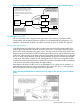

Intermediate routers are on the path between edge routers and the RP. This is known as a RP Tree
(RPT) where only the multicast address appears in the routing table. For example:
( *, G ), where:
* = a variable (wildcard) representing the IP address of any multicast source
G = a particular multicast group address.
NOTE: The software supports up to 100 RPs in a given PIM-SM domain.
Defining supported multicast groups
An RP in the default candidate configuration supports the entire range of possible multicast groups.
This range is expressed as a multicast address and mask, where the mask defines whether the
address is for a single address or a range of contiguous addresses:
Address rangeMaskMulticast address
224.0.0.0 - 239.255.255.255240.0.0.0224.0.0.0
An alternate way to express the above (default) address and mask is:
224.0.0.0/4
In non-default candidate configurations, an RP allows up to four ranges of contiguous multicast
groups, and/or individual multicast groups, or both. For example:
Supported range of multicast groupsRP candidate configuration
235.0.240.1 — 235.0.255.255235.0.240.0/12
235.0.0.1 — 235.0.0.15235.0.0.1/28
235.0.0.128 only235.0.0.128/32
235.0.0.77 only235.0.0.77/32
NOTE: If a given multicast group is excluded from all RPs in a given domain, then that group
will not be available to the multicast receivers connected in the domain.
For more on this topic, see “Configuring C-RPs on PIM-SM routers” (page 73).
C-RP election
Within a PIM-SM domain, different RPs support different multicast addresses or ranges of multicast
addresses. (That is, a given PIM-SM multicast group or range of groups is supported by only one
active RP, although other C-RPs can also be configured with overlapping or identical support.)
A C-RP's group-prefix configuration identifies the multicast groups the RP is enabled to support.
If multiple C-RPs have group-prefixes configured so that any of these RPs can support a given
multicast group, then the following criteria are used to select the RP to support the group:
1. The C-RP configured with the longest group-prefix mask applicable to the multicast group is
selected to support the group. Step 2 of this procedure applies if multiple RP candidates meet
this criterion.
2. The C-RP configured with the highest priority is selected. Step 3 of this procedure applies if
multiple RP candidates meet this criterion.
3. A hash function (using the configured bsr-candidate hash-mask-length value) generates
a series of mask length values that are individually assigned to the set of eligible C-RPs. If the
hash function matches a single RP candidate to a longer mask length than the other candidates,
98 PIM-SM (Sparse Mode)