
HP Comware-Based Switches Transceiver Modules User Guide

6
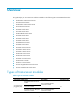
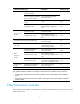
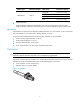
Figure 2 MPO connector
Connector index
WARNING!
The average output optical power of a long-haul fiber transceiver module is greater than the saturated
optical power. Be careful about the length of the optical fiber you use to make sure the actual received
optical power reaching the fiber transceiver module is less than its saturated optical power. Otherwise, the
fiber transceiver module might be damaged.
Output optical power
Output optical power is the output power of the optical transmitter of a fiber transceiver module, in
dBm.
Receiving sensitivity
Receiving sensitivity is the minimum optical power that is needed at the receiving end for the fiber
transceiver module to receive optical signals at a given data rate and bit error rate, in dBm. The higher
the data rate is, the greater the minimum input optical power is. A greater input optical power has
higher requirements on the receiving components of the fiber transceiver module.
Saturated optical power
Saturated optical power (also known as optical saturation) is the maximum input optical power at a
given data rate and bit error rate range (10
-10
to 10
-12
), in dBm.
Saturated photocurrent occurs if a fiber probe is irradiated by intensive light. When this occurs, it takes
the probe some time to recover. In this case, the receiving sensitivity worsens and the received signals
may be decided incorrectly, causing bit errors. This will probably damage the receiving probe. When
you perform operations, try to maintain a normal saturated optical power level.
Copper transceiver modules
Copper transceiver modules transmit signals over Category-5 unshielded twisted pair (UTP). UTP
transmission cover shorter distances than fiber transmission and can be used in small-sized networks only.
The HP Comware-Based Switches support the HP X120 1G SFP RJ45 T Transceiver (JD089B) copper
transceiver modules.
Transmission distance
Through UTP cables, signals can be transmitted over a distance of 100 m (328.08 ft.) only. This is because
signals attenuate during transmission through the UTP cables.