
R211x-HP Flexfabric 11900 High Availability Configuration Guide

76
• The NotReady state of the track entry shows that the accessibility of the next hop of the static route
is unknown, and that the static route is valid.
Follow these guidelines when you associate Track with static routing:
• You can associate a nonexistent track entry with a static route. The association takes effect only after
you use the track command to create the track entry.
• If the Track module detects the next hop accessibility of the static route in a private network through
NQA, the VPN instance name of the next hop of the static route must be consistent with that
configured for the NQA test group. Otherwise, the accessibility detection cannot function correctly.
• If a static route needs route recursion, the associated track entry must monitor the next hop of the
recursive route instead of that of the static route. Otherwise, a valid route might be considered
invalid.
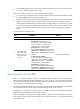
To associate Track with static routing:
Ste
p
Command
Remarks
1. Enter system view.
system-view N/A
2. Associate the static
route with a track
entry to check the
accessibility of the
next hop.
• Method 1:
ip route-static dest-address { mask |
mask-length } { next-hop-address [ track
track-entry-number ] | interface-type
interface-number [ next-hop-address ] |
vpn-instance d-vpn-instance-name
next-hop-address [ track track-entry-number ] }
[ permanent ] [ preference preference-value ]
[ tag tag-value ] [ description description-text ]
• Method 2:
ip route-static vpn-instance
s-vpn-instance-name dest-address { mask |
mask-length } { next-hop-address [ public ]
[ track track-entry-number ] | interface-type
interface-number [ next-hop-address ] |
vpn-instance d-vpn-instance-name
next-hop-address [ track track-entry-number ] }
[ permanent ] [ preference preference-value ]
[ tag tag-value ] [ description description-text ]
Not configured by default.
Associating Track with PBR
PBR is a routing mechanism based on user-defined policies. Different from the traditional
destination-based routing mechanism, PBR allows you to use a policy to route packets. You can specify
the next hop to guide the forwarding of packets that match specific ACLs. For more information about
PBR, see Layer 3—IP Routing Configuration Guide.
PBR cannot detect the availability of any action taken on packets. When the specified next hop fails, PBR
cannot sense the failure, and continues to forward matching packets to the next hop.
This problem can be solved by associating Track with PBR, which improves the flexibility of the PBR
application and enables PBR to sense topology changes.
After you associate a track entry with an apply clause, the detection module associated with the track
entry sends the detection result of the availability of the object (an interface or an IP address) specified
in the apply clause.