
R211x-HP Flexfabric 11900 IP Multicast Configuration Guide

123
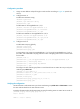
(::, FF1E::101)
Host slots (1 in total):
1
Host ports (2 in total):
XGE1/0/3
XGE1/0/4
The output shows that Host A and Host B have joined the IPv6 multicast group FF1E::101 (through the
member ports Ten-GigabitEthernet 1/0/4 and Ten-GigabitEthernet 1/0/3 on Switch A, respectively),
but the hosts have failed to join the multicast group FF1E::202.
Static port configuration example
Network requirements
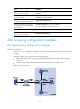
As shown in Figure 39:
• Router A runs MLDv1 and serves as the MLD querier, and Switch A, Switch B, and Switch C run
MLDv1 snooping.
• Host A and Host C are permanent receivers of the IPv6 multicast group FF1E::101. Configure
Ten-GigabitEthernet 1/0/3 and Ten-GigabitEthernet 1/0/5 on Switch C as static member ports for
the IPv6 multicast group FF1E::101 to enhance the reliability of IPv6 multicast traffic transmission.
• Suppose the STP runs on the network. To avoid data loops, the forwarding path from Switch A to
Switch C is blocked under normal conditions, and IPv6 multicast data flows to the receivers
attached to Switch C only along the path of Switch A—Switch B—Switch C.
• Configure Ten-GigabitEthernet 1/0/3 on Switch A as a static router port, so that IPv6 multicast data
can flow to the receivers nearly uninterrupted along the path of Switch A—Switch C when the path
of Switch A—Switch B—Switch C is blocked.
NOTE:
If no static router port is configured, when the path of Switch A—Switch B—Switch C is blocked, at leas
t
one MLD query-response cycle must be completed before the IPv6 multicast data can flow to the receivers
along the new path of Switch A—Switch C. IPv6 multicast delivery is interrupted during this process.
For more information about the STP, see Layer 2—LAN Switching Configuration Guide.