
R211x-HP Flexfabric 11900 IP Multicast Configuration Guide

130
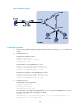
searches its IPv6 unicast routing table and finds that the outgoing interface to the source (the RPF
interface) is VLAN-interface 20. This means that the (S, G) entry is correct but the packet traveled
along a wrong path. The RPF check fails and the router discards the packet.
Configuration task list
Tasks at a
g
lance
(Required.) Enabling IPv6 multicast routing
(Optional.) Configuring IPv6 multicast routing and forwarding
• (Optional.) Configuring the RPF route selection rule
• (Optional.) Configuring IPv6 multicast load splitting
• (Optional.) Configuring an IPv6 multicast forwarding boundary
• (Optional.) Configuring static multicast MAC address entries
Enabling IPv6 multicast routing
Enable IPv6 multicast routing before you configure any Layer 3 IPv6 multicast functionality in the public
network or VPN instance.
To enable IPv6 multicast routing:
Ste
p
Command
Remarks
1. Enter system view.
system-view N/A
2. Enable IPv6 multicast routing
and enter IPv6 MRIB view.
ipv6 multicast routing
[ vpn-instance vpn-instance-name ]
By default, IPv6 multicast routing is
disabled.
Configuring IPv6 multicast routing and forwarding
Before you configure IPv6 multicast routing and forwarding, complete the following tasks:
• Configure an IPv6 unicast routing protocol so that all devices in the domain are interoperable at the
network layer.
• Configure IPv6 PIM-DM or IPv6 PIM-SM.
Configuring the RPF route selection rule
You can configure the router to select the RPF route based on the longest prefix match principle. For more
information about RPF route selection, see "RPF check process."
T
o configure an IPv6 multicast routing policy:
Ste
p
Command
Remarks
1. Enter system view.
system-view N/A