
R211x-HP Flexfabric 11900 IP Multicast Configuration Guide

37
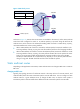
Figure 15 RPF check process
As shown in Figure 15, assume that unicast routes are available in the network, and no static multicast
routes have been configured on Switch C. A multicast packet (S, G) travels along the SPT from the
multicast source to the receivers. The multicast forwarding table on Switch C contains the (S, G) entry,
with VLAN-interface 20 as the incoming interface.
• When VLAN-interface 20 of Switch C receives the multicast packet, because the interface is the
incoming interface of the (S, G) entry, the router forwards the packet out of all outgoing interfaces.
• When VLAN-interface 10 of Switch C receives the multicast packet, because the interface is not the
incoming interface of the (S, G) entry, the router performs an RPF check on the packet. The router
looks up its unicast routing table and finds that the outgoing interface to the source (the RPF
interface) is VLAN-interface 20. It means that the (S, G) entry is correct, but the packet traveled
along a wrong path. The RPF check fails and the router discards the packet.
Static multicast routes
Depending on the application environment, a static multicast route can change an RPF route or create an
RPF route.
Changing an RPF route
Typically, the topology structure of a multicast network is the same as that of a unicast network, and
multicast traffic follows the same transmission path as unicast traffic does. You can configure a static
multicast route for a given multicast source to change the RPF route, so that the router creates a
transmission path for multicast traffic that is different from the transmission path for unicast traffic.
Source
192.168.0.1/24
Receiver
Receiver
Switch A
Switch B
Switch C
Vlan-int20
Vlan-int10
Vlan-int10
Multicast packets
Destination/Mask
IP Routing Table on Switch C
192.168.0.0/24
Interface
Vlan-int20