
R211x-HP Flexfabric 11900 IP Multicast Configuration Guide


71
SPT building
The decision to build an RPT for PIM-SM or an SPT for PIM-SSM depends on whether the multicast group
that the receiver wants to join is included in the SSM group range (232.0.0.0/8 reserved by IANA).
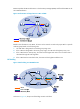
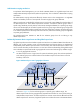
Figure 31 SPT building in PIM-SSM
As shown in Figure 31, Host B and Host C are receivers. They send IGMPv3 report messages to their DRs
to express their interest in the multicast information that the multicast source S sends to the multicast group
G.
After receiving a report message, the DR first checks whether the group address in this message is in the
SSM group range and does the following:
• If the group address is in the SSM group range, the PIM-SSM service is provided.
The DR sends a subscribe message toward the multicast source. All routers along the path from the
DR to the source create an (S, G) entry to build an SPT. The SPT is rooted at the multicast source and
has the receivers as its leaves.
• If the group address is not in the SSM group range, the PIM-SM service is provided.
The receiver-side DR sends a (*, G) join message to the RP, and the multicast source registers with
the source-side DR.
In PIM-SSM, the term "channel" refers to a multicast group, and the term "subscribe message" refers to
a join message.
PIM support for VPNs
To support PIM for VPNs, a multicast router that runs PIM maintains an independent set of PIM neighbor
table, multicast routing table, BSR information, and RP-set information for each VPN.